
Immediately in my editorial of this unique issue on The Textile Museum
in Washington DC, I would like to thank all those associated
with its publication from the Director, Ursula Eland McCracken, through
all the contributing authors, the studio photographer, Franko Khoury, to
the otherwise anonymous Maury Sullivan, Public Information Manager, who
has so ably and harmoniously acted as intermediary between the contributors
and ourselves. The mission statement that has been provided would also seem
to find an appropriate place here:
"The Textile Museum is dedicated to furthering the understanding
of mankind's creative achievements in the textile arts.
"As a museum, it is committed to its role as a center of excellence
in the scholarly research, conversation, interpretation and exhibition
of textiles, with particular concern for the artistic, technical
and cultural significance of its collections.
"The mission is pursued through development and maintenance
of collections, records and a library, as well as through scholarly
research, exhibitions, publications and educational programs.
"In all of this, the standard of excellence established by the
Museum's founder, George Hewitt Myers, will be maintained."
It is rather more than two years since, when visiting Washington,
I was introduced by an art dealer friend to the collections of
The Textile Museum, which founded by American benefactor George
Hewitt Myers (1875-1957) possesses today a fantastically rich
store of more than fourteen thousand textiles, and fifteen hundred
carpets and rugs.
My suggestion a month or two later for a Textile Museum feature
was enthusiastically received by the Trustees and the Director,
Ursula Eland McCracken who has written the Introduction on pages
55-57. A planning meeting was held and the various coverages
assigned. Notably Carol Bier (Curator, Eastern Hemisphere Collections)
writes on the Oriental carpets section, and the very well-known
author/scholar Mattiebelle Gittinger on the Southeast Asian textiles
which are her specialist field. From the museum's curatorial
staff, Lorna Carmel (who we recently had the pleasure of meeting
in Hong Kong on her way back from a China visit) covers Central
Asian textiles, and Louise W. Mackie, Curator, Royal Ontario
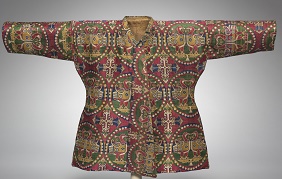
Museum, Toronto, the Islamic collections. Starting with early
Islamic curtain, veil and robe fragments dating from the eighth
to tenth centuries, she takes her subject through the ages, with
velvets, silks and cottons, up to the twentieth century, with
hitherto unpublished examples such as a recent accession, the
Mughal carpet seen on the cover of this magazine with a detail
and on page 68. While this is a short summary of the textiles
part of this number, which I feel sure you will enjoy whether
you are already knowledgeable on the subject or it is new to
you, please address or call The Textile Museum at 2320 S Street,
NW, Washington DC 20008-4088, USA, tel: (202) 667-0441, fax:
(202) 483-0994, for more information on forthcoming exhibitions,
future programmes and membership.
Though my editorial is necessarily being written towards the
end of November, 1995, for the benefit of our loyal supporters,
both our subscribers and our advertisers, by early December we
should have a web site on the Internet at http://www.hk.linkage.net/~artsasia
- perfect timing before Christmas and the New Year. The long-term
reaction is forecast to be excellent and I will return to this
subject again when more is known.
Incidentally, I would like to take this opportunity to stress
for our readers, and especially newcomers that ARTS OF ASIA is
without doubt the very first of its type since World War Two
to have been specifically founded to follow Asian art trends
and their historical backgrounds. Do not believe claims you may
hear by any other publication which has followed our style, with
the purpose of "cashing in" on our undoubted success. For our
success in publishing is based on consistent study and hard work
in following the needs of our supporters. I and my husband have
been loyal to the magazine since its foundation in 1970, while
our son Robin Markbreiter who has been working with us since
the past five years, has gained valuable experience and is a
considerable asset. There must be few, if any publications let
alone art ones, that can boast such continuity.
It is ARTS OF ASIA that follows and covers the art market most
closely, whether through reports on exhibitions, dealer and auction-house
sales, society symposiums, or reviews of books on topical subjects
as regular subscribers are well aware. I have frequently been
told that my own editorials are eagerly read, as also are our
correspondence pages with letters from readers. Such features
are rarely found in magazines today because of the amount of
time involved in researching and assembling them, and the range
of knowledge that is necessary.
In support of the formerly named Netsuke Kenkyukai Society,
I travelled overseas with Robin as photographer to attend and
record their New York City Convention held from September 8th
through 15th. The full report by Sharon Ziesnitz can be found
on pages 150-157. Sharon's first of six articles for us appeared
more than nineteen years ago on "Ikebana Basket Art".
I am frequently asked by travellers from Asia to name good hotels
to stay. I can highly recommend the New York Palace, 455 Madison
Avenue, New York, New York 10022, tel: (212) 888-7000, fax: (212)
303-6000, where the convention was held. I see from the Netsuke
Society's 1995 membership directory that there are now more than
five hundred and fifty members. The board of directors and members
attending the convention unanimously voted to change the name
to The International Netsuke Society.
Many of the members are enthusiastic subscribers to ARTS OF
ASIA. It was a pleasure to meet them, attend the lectures and
workshops, and update and expand my knowledge of the subject.
Viewing the displays in the dealers' booths, under one roof,
was a lesson in itself. Sad to say, from my notes for new collectors, "good
netsuke by famous Japanese artists, such as Masanao, Tomotada,
Yoshinada, Tomosaku, Ikan and Shoko, mainly of the eighteenth
century, are already in the hands of wealthy collectors or in
museums, and very few are available for sale at a reasonable
price." However, a worthy collection can still be formed by seeking
out those early artists who may not be in favour at the present
time.
I was impressed by the works of art by new Western contemporary
artists, such as David Carlin, Valerie Barber, Clive Hallam,
Guy R.H. Shaw and Michael Birch (see page 156). Here are a few
guidelines. New collectors of netsuke should first look for good
subjects. Apparently this is very important. Then the pieces
should have some intrinsic power. If collecting wood or ivory,
the patina is another criteria to look for. New collectors should
strive to have the chance to see and handle great pieces, so
they can distinguish what is good. Through looking at a great
collection you are focusing on an acknowledged collector's taste.
Mr Chen Dong Shen, Chairman and Chief Executive Officer of China
Guardian Auctions Co., Ltd, invited me to Beijing to attend their
seven-catalogue October 1995 auctions. The sales in order were:
first day, October 7th, Chinese Oil Paintings and Sculptures,
followed by Rare Books; second day, October 8th, The Yeung Wing
Tak collection of Important Qi Baishi Paintings in the morning
and Chinese Paintings and Calligraphy in the afternoon; third
day, October 9th, Jewellery and Jadeite in the morning, Chinese
Porcelain and works of Art in the afternoon, and The Qing Shui
Shan Fang Collection of Ming and Qing Furniture in the evening.
A highlight of the sale of oil paintings was Lot 11,
Chairman
Mao Goes to Anyuan by Liu Chunhua, 220 x 180 cms, which
went on a successful bid of RMB6.05 million (US$737,800), more
than three times the high estimate, to a Chinese gentleman
in his forties sitting just behind me. Interestingly, when
we first illustrated this painting in an article by my husband, "Minor
Arts during the Cultural Revolution: a collection of memorabilia",
March-april 1987, it was described on page 117 as being a "collective
painting by Liu Chun-hua and other students of Peking's universities
and colleges". Two pages later, the same painting was illustrated
in miniature as the August 1st, 1968 postage stamp of The People's
Republic of China.
I cannot resist reprinting my husband's description of this
painting some eight and a half years ago:
"The Annigoni-type picture of the young Mao is as much a part
of the Cultural Revolution as the red book and the badges. It
suggests the hand of a skilful academic, though said to be the
work of a collective of Red

Guards
from Peking universities and colleges, with the design and main
execution by a twenty-four year old student of decorative arts
who had never before specially studied oil-painting. A youthful
and determined Chairman Mao is seen walking from his native Hunan
province to An-yuan in Kiangsi, to organise a strike at the coal
mines in 1922 followed by a more major uprising in 1929. The
main purpose of the wide distribution of reproductions of this
painting ('Shanghai printers went all out and printed two million
copies of the portrait in less than four days') was to make sure
of the unquestionable status of the Chairman as the leader of
the workers' movement and that the credit should go to no one
else. Especially not to Chief of State Lui Shao-ch'i, his political
adversary."
Rather than reprint this whole painting a third time, I am showing
it partly obscured in the auction room attended by more than
seven hundred people (1) and as a souvenir photograph with myself
and the Chen Dong Shen family (2). Out of interest I sat through
the whole of the sale of Qi Baishi paintings, Lots 181-345, and
even bought, I think quite reasonably, Lot 286,
Baby Chickens (3)
which are escaping from a bamboo basket, the lead chick with
a worm in its beak. The title slip is by Li Keran. The hammer
went down at RMB110,000 (US$13,415). To this must be added the
buyer's premium, a standard ten per cent with China Guardian,
rather less than the fifteen per cent that is usual in Hong Kong.