
TO BE SELECTED to have independently translated from the Chinese and
published in English the two leading articles of this January-February,
2001 issue is recognition indeed of the high status of Arts of Asia in
both Western and Asian art worlds. This magazine is appreciated on the
mainland of China (particularly in Peking, Shanghai and Canton), in the
Hong Kong SAR (Special Administrative Region), as also in Taiwan. My own
nine-page Collectors World report covers the recent exhibition, held last
October in Taipei, by the eight members of the Taiwan Antique Dealers'
Association.
|
Where Arts of Asia leads, surely others will follow!
The two archaeological articles we have had translated
by Brenda Li in Hong Kong, were written for us in Chinese
by three specialists born in Qingzhou, Shandong province.
The first article by Wang Ruixia and Zhou Linlin, the second
by Sun Xinsheng. Importantly, they support the exhibition
of Chinese Northern Qi sculptures excavated at the Longxing
Temple in Qingzhou, that will be held jointly with the
Hong Kong Museum of Art, from January 19th to April 15th,
2001.
In our support of international art dealers overseas as
well as of museums and their scholars, Robin Markbreiter
covers the third Asian Art in London, November 9th to 17th,
2000 illustrated with his own lively photographs of the
activities and some of those who were present.
|

(1)
|
On October 4th, 2000 John Ang of Artasia wrote from Taipei to invite
me to attend his company's tenth anniversary exhibition, "The Beauty of
Asian Art". This features Buddhist art, ceramics, textiles and Chinese
furniture. Lectures in Chinese and in English included "Gustav Ecke's
contribution to the understanding of Chinese Ming furniture and the development
of contemporary Chinese furniture" by Betty Ecke (1), a prominent artist
and arthistorian in her own right, on Sunday, October 22nd; and "Song
dynasty Temmoku tea bowls" by the gallery owner John Ang on Sunday, November
5th.
Seen at the opening on Saturday, October 21st, either side of Betty Ecke
are John Ang and his business partner Jane Fong (their assistant Philip
Chen is behind her) (2). A photograph of myself follows with friends,
Maggie Pai the writer, and her husband well-known Taiwan architect Bai
Chin (3). The Artasia show confirmed for me that collecting in Taiwan
has matured considerably over the last ten years.

(2) |
In fact, in John Ang's view, Hong Kong collectors should be
made aware they have actually lagged behind in terms of obtaining
the best pieces. He points out that in several shows in Taipei
last October and later, as well as his own, there were examples
of Northern Qi dynasty horses. Such an occurrence will be short-lived,
he predicts, as the numbers are limited and the dynasty only
lasted twenty-seven years (AD 550-577). Among excavated Tang
pieces the plump pottery ladies are still the most popular.
Up to the late eighties, John explains, they commanded extremely
high prices, but prices then fell when too many came on to the
market. But since the late nineties prices for large fine examples,
50 cm or more high, have continued to rise as Taiwanese collectors
are no longer deterred by traditional thinking that excavated
figures bring bad luck. However, Chinese collectors from Hong
Kong and Singapore still tend to stay away from tomb pieces.
But while in the past they would go quickly through Hong Kong
to Europe and the USA, now some of the most fantastic examples
can be seen in exhibitions in Taiwan,

(3) |
such as at the Ching Wan Society
Millennium Exhibition (by a leading group of thirty-two
Taiwanese collectors and six honorary members founded in
1992) held at the Chang Foundation Museum running from
October 7th to November 5th, 2000. Seen as well at Artasia's
own gallery at 1st Fl., 436, Sec.4, Jen Ai Road, |
Taipei, Taiwan Tel: 886-2-87801242 Fax: 886-2- 87801347, from
their ceramics on displayis a Northern Song funerary yu ware
celadon four-handled jar and cover (4) (a similar example is
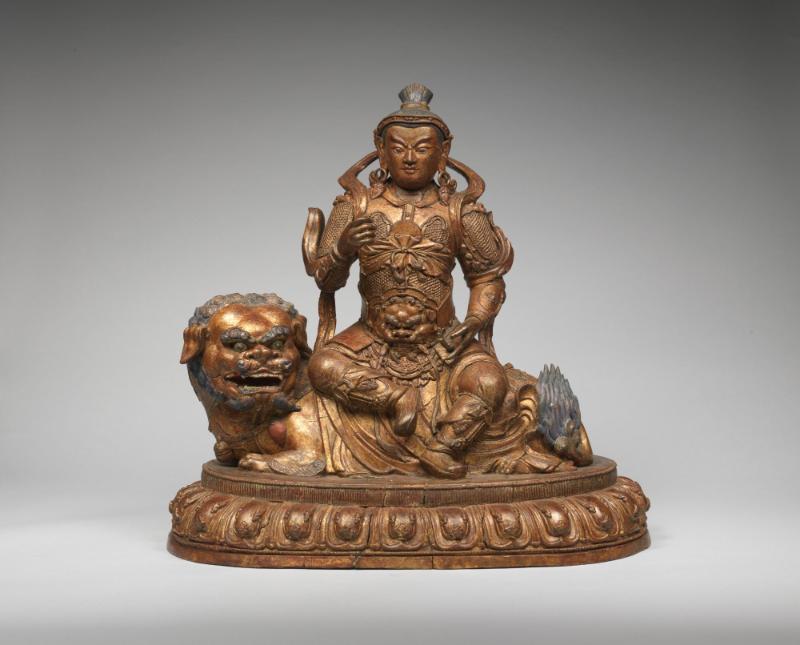
in the Shanghai Museum); and of their collection of Tibetan gilt
bronzes an active figure of Yamantaka Vajrabhairava, 16th century,
in very fine condition. (5).
(4) |

(5) |
It was a pleasure for me to meet Mr Tu Cheng-sheng, the latest
Director of the National Palace Museum. (I have now in over
thirty-one years, in turn reported on my first meetings with
three distinguished directors of that fabulous near inexhaustible
historic Chinese Imperial art collection.) We met in Mr Tu's
office at the museum on the early morning of October 21st,
where he presented to me for the Arts of Asia Foundation study
library his handsome book,
The Genre Paintings of Taiwan's
Aboriginal People. This was published in Chinese with summary
in English by the Academia Sinica, Taipei, in 1998. Reproductions
of paintings in conjunction with other documents and illustrations
among the holdings of the Academia Sinica, it is the basis
for an investigation into Taiwan's early history, society and
culture. Sources used date to as late as the 19th century,
but the work focuses on the 150 years between 1600 and 1750.
A noted historian, with numerous publications
on ancient China to his credit, Director Tu studied at the
Department of History, National Taiwan University, for his
BA 1970, and MA 1974, followed by three years at the London
School of Economic and Political Sciences, 1974-1976. A later
overseas London University appointment has been Visiting Scholar,
School of Oriental and African Studies, 1992- 1993. As well
as numerous research and academic awards, his escalating high-level
positions include Research Fellow, Institute of History and
Philology, Academia Sinica, since 1984; Director, Graduate
School of History, National Tsing-Hua University, 1986-1987;
Academic Advisor, Ministry of Education, 1994-1998; and Director,
Institute of History and Philology, Academia Sinica, 1995-2000.
Director Tu was thoughtful (6) and open (7) to
me, explaining that his present position has the rank of a
Cabinet Minister and will last as long as the current President
of Taiwan remains in power. Of the changes he plans, first,
he has already obtained the financial

(6) |
backing from the Government to improve the
museum's main gate, repair and redecorate all the relevant
exhibition galleries, and to bring in new younger experts
to work for the museum in various departments. |

(7) |
The new posts are open to everyone with the right qualities
and experience and the positions available have been posted
on the Internet. Director Tu has organised a committee to study
every application which will establish the three most suitable
candidates in each case, irrespective of nationality, for his
final selection. This is a change of regulation that he is
proud of establishing.
His long-term aim is to have the budget to present Asian and
European art in a separate wing. He feels the scope of the
museum is at present too limited to showing the arts and culture
of China. "We have to think in more global terms" he says.
For the year 2003 there will be an exhibition of French paintings
from the 17th to 19th centuries, organised by more than ten
French museums including the Louvre.
Our trip to London is rather comprehensively
covered by Robin Markbreiter following on from my Editorial.
On the way back to Hong Kong we broke our journey in Istanbul
for three days, just long enough to have a working session
with Ms Filiz Cagman, Director of the Topkapi Palace Museum
(who is seen in her Topkapi office with Mr Tarik Yalvac,
Consul General of Turkey, Hong Kong, who introduced us
(8) ). We also attended |
 (8) |

(9) |
the opening of the Orient House art gallery
on Friday, November 17th, at Vali Konagi Caddesi, Saroglu
Apt. No. 83, Kat 1, D.5 Nisantasi, Istanbul, Tel: 90-212-2247620/21
Fax: 90-212-2247622. Mr A. Osman Mayatepek, Chairman and
CEO of the Elsan Group, seen on the left of the picture
(9), introduces Mr Mark B.Sandground, Sr, President Elsan-USA,
senior partner of an international law firm, and Chairman
of the Orient House group of companies. |
|
Mr Sandground pointed out that in the
Topkapi Palace in Istanbul, Turkey hosts one of the greatest
collections of Ming porcelains. (As you enter the second
courtyard, the first enclosure today, through the original
middle gate of the complex (10), the former old palace
kitchens that house the great collection of Chinese ceramics
amassed by |

(10) |
(11) |
Sulaiman the Magnificent are
on your right (11). They begin with 13th century celadons
and continue with Chinese porcelains of the 14th to 17th
centuries, but are presently closed for renovations.The
entrance to the harem is from the opposite side of the
courtyard, and an arched |
doorway beneath a charming portico (12) at the far end leads
to the audience room.)
|
"In this melting pot of civilisations we see the most
sophisticated blend of East and West in Istanbul, gateway
to the Balkans, Middle East, Caucasia, Central Asia and
Europe. We want to contribute to the Oriental heritage
in this country (Turkey) which so magnificently inspires
us," Mr Sandground says.
|

(12) |
We have a challenge here. We have to live up to your expectations
as well as to the standards we have set for ourselves. As Istanbul
is a gateway in this part of the world, our Orient House will
also serve a gateway to the best examples of Oriental art."As
Goethe said, `Let objects slowly raise us to their levels.'''
On that challenging note we returned to Hong Kong in time to
complete this first number of the 2001 year to printing stage.
Despite a general economic slowdown in the year 2000 we have
maintained our standards, continuing to expand on new areas
of art collecting, such as the informative article by Sian
E. Jay in this number on "The Mark Gordon Collection'',
and Mark's own revealing "Judging Authenticity in Tribal
Art''. This issue is equally useful and topical with its articles
by Keith Stevens on "Luohans on Chinese Altars'' and Kerry
Nguyen-Long on "Treasures from the Hoi An Hoard'' of Vietnamese
ceramics. We also introduce a new feature on smaller specialist
family museums, which deserve wider exposure internationally.
On this first occasion, "The Tareq Rajab Museum, Kuwait'',
written for us by long time contributor, Jehan S. Rajab.
I would like to wish all my subscribers, contributors and
advertising clients Happiness and Prosperity for the year of
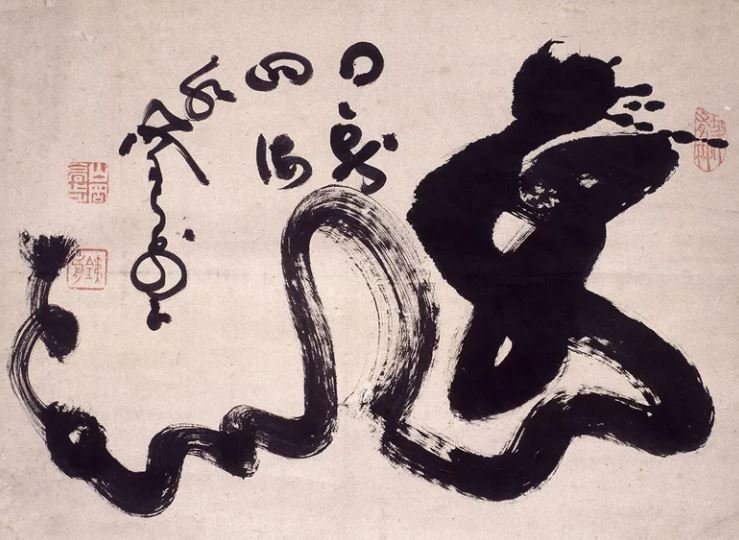
the snake, which commences on January 24th, 2001.