
editorials - March - April
2001 |
 |
|
|
|
|
I AM GRATEFUL to Dr Hugo E. Kreijger, Asian Art Consultant to the Southeast
Asian Department of Christie's International, for arranging a wonderful
programme during my recent trip to Holland with my friend Thomas Murray,
the asiatica and ethnographica specialist.
Together, on Tuesday, January 9th, we visited in the morning the Asian
Department of the Rijksmuseum in Amsterdam, where we were greeted and
shown around by Ms Pauline Lunsingh Scheurleer, author of the article "An
Introduction into Majapahit Ornamentation" in our November-December
2000 magazine. Definitely, the strongest feature of the Asian Department,
on the museum's ground floor, is the group of Indonesian sculptures. As
much as I would have liked to have been able to view in depth the department's
Chinese and Japanese porcelain collections, my time was too short.
We dashed at 12:30 pm to Sotheby's Amsterdam, to meet their Deputy Director,
Drs Feng-Chun Ma, who showed us their very elegant, well-organised new offices,
with a staff of forty, and conveniently in front of the building their own
very large car park. Invited to meet me at lunch at Sotheby's was Dr W.E.
Bouwman, Director of Kunsthandel Aalderink B.V., one of the longest established
galleries in Amsterdam.
After lunch, the whole of the afternoon was spent visiting the Royal
Tropical Institute, which I discovered has the largest textile collection
from Indonesia, as well as one of the finest collections of Indonesian
tribal art. For those of our readers who are interested in the culture
of Indonesia I strongly recommend they visit their coming exhibition "Drawn
in Wax-200 Years of Batik Art from Indonesia" from April 10th-October
14th, 2001.
|
The early evening was spent at the gallery of Mr Jaap
Polak, where we also met another contributor to the November-December
2000 magazine: Dr Nandana Chutiwongs, Curator, Leiden Museum.
Jaap Polak sells Western furniture, but since several years
has collected Indonesian bronzes. He is well known to have
the best documented collection, which I can well believe
from his photographic albums. I spent an hour and a half
being briefed by him.
On the morning of Wednesday, January 10th, we took the
train to Rotterdam, visiting the exhibition "Majapahit: The Golden Age of Indonesia" at
the newly renovated and renamed Wereldmuseum, whose ex-Curator, the
recently retired Drs Anneke
|
 (1)
|
Djajasoebrata, is seen with me in our first photograph (1), while
Hugo and Thomas are standing behind. Since I collect Indonesian jewellery
and bronzes, and in a sense "sponsored" our November-December
2000 magazine with its coverage of "The Golden Age of Indonesia, Late
13th-Early 16th Century", I was delighted to view these collections
in the company of such experts. The exhibition runs on to May 25th, 2001,
and I urge our readers to make an effort to see it.

(2)
|
Of course, I was present at the ouverture
(opening) (2) at the Guimet, Musée National des Arts Asiatiques,
6 place d'Iéna (near the Eiffel Tower), 75116,
Paris, on Monday, January 15th, 2001, as the invitation
directed between 3-6 pm. Present rather earlier that
morning at 11 am, were President Jacques Chirac, with
Madame Pompidou and Madame Catherine Tasca, Minister
of Culture, seen with Mr T.T. Tsui from Hong Kong (3),
a major donor to the Guimet Museum, who had a special
presentation for themselves with very high security protection. |
Since I first saw the Musée Guimet as a young visitor
in Paris in 1955, and again on my honeymoon with my husband
in 1959, and a number of times after then, the interior of
the building has been largely reconstructed, though its dignified
classical exterior has thankfully been retained. (See he article "The
Renovation of the Musée Guimet-Towards a New Understanding
of Asian Art in Paris", by Conservateur général,
Directeur Jean-François Jarrige, Arts of Asia, September-October
2000.)
My first impression now of the formerly dusty and neglected, rather incoherent
interior, is the wonderful natural light that permeates the entrance hall
of the ground floor and focuses on the beautiful Khmer sculptures (4). Jean-François
Jarrige has described this reconstruction very clearly in his article the
effect is stunning.

(3) |

(4) |
The cost of the renovation, which I assume is still continuing,
was US$48 million. Three of the museum's five floors are available
to the general public following the ouverture as follows: ground
floor (public areas, library, bookshop, Indian and Southeast
Asian Collections); first floor (Riboud, Chinese, Central Asian,
Afghanistan-Pakistan and Tibet-Nepal Collections); and second
floor (Chinese, Korean and Japanese Collections). The third
and fourth floors were not open to us, but I believe these
will also probably house the Chinese Collections which are
extensive. In all, to date, some 3500 pieces from a variety
of categories are on display from a collection total of 45,000.
I was a little disappointed that there was no allocation for
Asian textiles, but overall the new spacious and bright Musée
Guimet can claim to be one of the most important repositories
of Asian artefacts. I should also point out that the Japanese
Collection on display and the presentation of sculptures from
Afghanistan and Pakistan are superb. During the opening there
was a strong turnout from New York and groups, among them my
friend Liza Hyde the well-known dealer of Japanese screens,
were led through the galleries by Amy Poster of The Brooklyn
Museum and Alexandra Munroe of the Japan Society Gallery.
Seen with me on the ground floor
are, on the left of the photograph, Filippo Salviati, the
jade expert from Rome, and on the right of the photograph
Samuel and Myrna Meyers, whose jade collection Dr Salviati
catalogued last year (5).I visited while in Paris the Meyers'
collection of archaic jade and was most impressed with
the attributions and its quality. |

(5)
|
Amongst several of the friends I met at the museum galleries,
seen here are Pansy Hui, of Christie's Hong Kong, with Dr Kenson
Kwok, Director of the Asian Civilisations Museum, Singapore
(6); and Mrs K. Wang-King, daughter of the internationally-known
Chinese painter and senior authority, C.C. Wang, with Dr Hugo
K. Weihe, Head of Asian Art, Christie's New York (7).

(6)
|

(7)
|
But undoubtedly most fortuitous, I met James J. Lally also
from New York, the highly respected independent Asian art dealer
and was delighted as a result to receive from Jim the following
letter when I was back in Hong Kong:
"It was a pleasure to see you in Paris at the reopening
celebration of the Musée Guimet, and then once again
at the Hong Kong Museum of Art for the exhibition of the important
selection of Buddhist stone sculptures excavated in Shandong.
"In response to your repeated enquiries regarding the
new Guimet interior and installation, it is hard to know how
to respond. We are all delighted that the French national museum
of Asian art is finally reopened after being closed for too
long, and the renovation of the interior is a tremendous improvement,
to say the least. There is such an opening-up of the interior
space and so much more natural light, that the difference is
quite extraordinary and yet they were able to save the marvelous
old façade of the original building, and I am delighted
by that. The installation of the sculpture on the ground floor
makes the best use of the new interior and it has tremendous
impact-how could it fail with so many masterpieces! The flow
between the various galleries upstairs is tremendously improved,
and the architect must be congratulated for making it possible
for us to perambulate the building with ease.
"I am not qualified to comment in any serious way regarding
the Japanese and Korean and Indian and the other non-Chinese
installations, although I was particularly impressed by the
Korean galleries. But you know that Chinese art is the only
field which I have attempted in any depth. When we met in one
of the Chinese sculpture galleries, it was immediately clear
that you and I had the same reaction to the reinstallation:
delight in seeing so many "old friends" back on display,
but bewilderment at the idiosyncratic selection and the inconsistent
presentation. In short, it is a wonderful collection in a thoroughly
modern facility, but the full potential for a beautiful and
informative display of the best works of art is not yet fully
realized.
"The new Musée Guimet is a tremendous step forward.
Everyone who has plans to be anywhere near Paris should not
fail to visit. I certainly won't go to Paris without spending
considerable time there, and I am confident that the display
will be better presented, better lit and better labeled each
time I visit."

(8)
|
I would have liked to extend my Paris
trip to visit art galleries, however I had to rush back
to Hong Kong to attend the opening ceremony of the exhibition "Buddhist Sculptures:
New Discoveries from Qingzhou, Shandong Province" at
the Hong Kong Museum of Art (8) on January 18th. Featured
on the cover of our January-February 2001 magazine, the
exhibition of 100 Chinese Buddhist sculptures which runs
until April 15th, offers a unique opportunity to view the
artistic style of stone sculptures from the Northern Wei
(386-534) to Northern Song (960-1127) dynasties. |
Seen standing at the ribbon
cutting ceremony (9), are from the left, Mrs Maisie Wong,
Chairman of the Friends of the Hong Kong Museum of Art,
Mrs Zheng Ruzhi, Deputy Mayor of Qingzhou City, Shandong
province of the PRC, Ms Choy So-yuk, Member of the Legislative
Council, Mr Lam Woon-kwong, JP, Secretary for Home Affairs,
Mr Zheng Xinmiao, Deputy Director of the National Administration
for Cultural Heritage of the PRC, Ven. Kok Kwong, President
of the Hong Kong Buddhist Association, Mr Wang Huaqing,
Director of the Qingzhou City |

(9) |
 (10) |
Museum of the PRC, and Mr Paul S.W. Leung, JP, Director
of Leisure and Cultural Services.
One person who deserves much credit for bringing the
exhibition to Hong Kong is Gerard Tsang (10), Chief Curator
(Policy Review) of the Hong Kong Museum of Art. When
I spoke with him in the galleries he explained that it
had taken two years to finalise the arrangements to bring
the pieces to Hong Kong. When he first saw the sculptures
at the Qingzhou City Museum he was captivated by the
beauty of the stone carvings and the serene expressions
on the Buddhas. The Hong Kong Museum of Art's exhibition
is the largest of its kind to be held in town and the
presentation was the best ever staged at the museum.
Many of the sculptures are standing figures, some of
monumental size, and will surely attract visitors from
around the world.
|

(11)
|
There is no doubt that the gala
preview opening of the 5th Annual San Francisco Arts of
Pacific Asia Show, benefitting the education programs of
the Asian Art Museum/Chong-Moon Lee Center for Asian Art
and Culture, held on Thursday, February 1st, was a great
success. |
Congratulations are in order
for co-chair Joan Lee Vinson for staging with organisers
Caskey-Lees such an original and most appealing entrance
(11). Joan and fellow co-chair Gorretti Lo Lui raised over
US$250,000, considerably more than previous years, and
had an attendance of nearly 1000 guests each paying US$175
for tickets. They are seen in the centre of our photograph
(12) with Joan's daughter Clare and husband Glenn on the
right, and Bill Caskey and Elizabeth Lees on the left. |

(12)
|

(13)
|
Although a few guests were not accustomed to the loud
drums accompanying the New Year's lion dance, traditionally
staged to ward off evil spirits and bring good luck,
I found it delightful as the performers included young
children (13).
There was also plenty to drink and eat including caviar
and fresh prawns, and the caterers served from lavish
buffet tables and sushi bars up to 10 pm when the party
ended. Distinguished guests included Tim Hormel, Ambassador
to Luxembourg, venture capitalists Frank Caufield and
Sandy Miller, Carl Pascarello, CEO of Visa, USA, and
Asian art collectors Willard Clark, Chong-Moon Lee, Rick
Fabian and Marjorie Bissinger, Dr Emily Sano, centre,Director
of the Asian Art
|
|
Museum, is seen with me and Dessa Goddard, Butterfields'
Vice President and Director of Fine Asian Works of Art
(14). In her welcoming address Emily thanked the sponsors,
guests and organisers for their continuous support. Following
her speech the door prize drawing was held and guests
stayed to see whether they would be lucky winners.
On the opening night I also enjoyed meeting our subscribers,
contributors, friends and guests including Mr Susanto
Prio Utomo, Indonesian Consul General, and his wife
|
(14)
|

(15) |

(16) |
Silvy. (#15).Many said they truly enjoyed the exotic wood canopy
entrance featuring original 18th/19th century bracketing from
Ningbo in China exhibited by Evelyn's Antique Chinese Furniture,
Inc. Folk Art International also contributed to make the entrance
particularly inviting. Director Marsha Vargas (16), with the
assistance of interior designers, oversaw the tasteful arrangement
of their impressive Southeast Asian stone Buddha, Tibetan thangkas,
Chinese carpet and Gandharan stone sculpture.
 (17) |
The following three show days (one day shorter than
the previous year) were extremely busy at our Arts of
Asia stand where we talked with new and old subscribers
and sold over 500 magazines. For our readers who were
unable to attend the show I have selected from the works
of art and displays I found particularly interesting
and attractive of the eighty-two participating dealers.
Robyn Turner is well known as a specialist in Chinese jades so I was
pleasantly surprised to find on her beautiful stand a group of Japanese
Meiji ivory carvings. I have chosen to illustrate a male figure playing
a flute with a female at his side holding a sword (17).
|
|
Exhibited next door at Shakris Fine Asian Works of Art
was a rare and fine large cast bronze seated Buddha in
dhyanasana with his hands poised in bhumisparsa mudra
(18). The crisply cast facial features and serene expression
is typical of the Lanna School, 14th/15th century, in
northern Thailand.
Imari Inc. specialises in Japanese antiques and particularly
in screens. They had a beautiful two-panel folding screen
depicting a cluster of flowering peonies and rocks along
a meandering shoreline veiled in mist and clouds. (19).
|
 (18) |

(19) |

(20) |
|
The elegant screen is dated Edo (Tokugawa) period, late
18th century, and executed in sumi with colour and flecks
of gold leaf on gold leaf applied paper and mounted on
wooden frames.
One of the earliest and rarest pieces in the show was
a bronze figure of Buddha from Kashmir dated circa 9th/10th
century from Folk Art Inernational (20).What makes this
piece particularly special are the two lions in openwork
over a lotus petal frieze. The seated Buddha's hands
are raised before his chest in the gesture of teaching
and he wears a closely fitting sanghati finely incised
with a zigzag border.
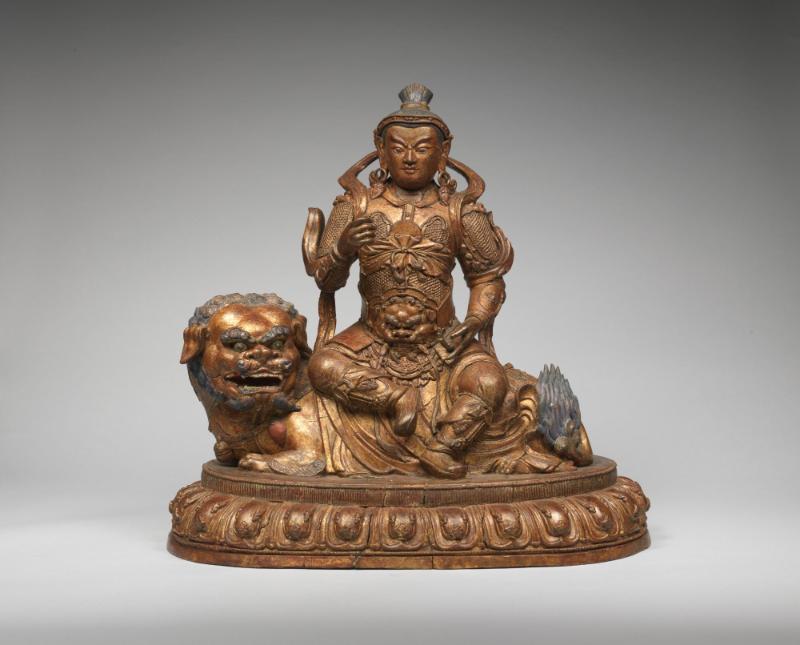
Robyn Buntin of Honolulu had an impressive and large
pair of Japanese Bishamon-ten and Jikoku-ten "guardian
kings" (21). They were originally Hindu protective
deities absorbed into the Buddhist pantheon and assigned
to guard the four cardinal directions against evil.
|
 (21) |

(22)
|
I was also very pleased to see my good friend Florence Chong of Hobbs & Bishops
Fine Art, Ltd (22). She had shipped from Hong Kong for the second year running
quality Chinese furniture at reasonable prices.
Tai Gallery/Textile Arts from Sante Fe was exhibiting in
San Francisco for the first time and was very pleased with
the show. Owners Robert T. Coffland and Mary Hunt Kahlenberg
had brought with them examples of their finest bamboo baskets
(23) signed by respected Japanese contemporary artists. The
decision to display their best pieces was rewarded with successful
sales.
Art of the Past also brought fine early pieces. An example
from northern India is a 10th-11th century sandstone sculpture
of Shiva with his adoring consort Parvati (24). Many visitors
commented on the image's elegance and movement.
Tim Mertel of L'Asie Exotique told me they had a pretty good
fair selling a number of items from all different cultures
including Chinese scholar items, ceramics from the Hoi An Hoard,
Chinese furniture, Japanese Meiji ceramics and ningyo dolls
(25). His partner Alan Pate will be giving a lecture, Japanese
Ningyo: Festival dolls of the Edo Period, in the main auditorium
of the Metropolitan Museum of Art at 3:00 pm on Sunday, March
4th. This is in conjunction with the reinstallation of the
Japanese galleries featuring art from the Edo period including
ningyo from the Ayervais Collection.
(26) |
Thomas Murray always tries to educate visitors
to his stand by showing unusual pieces. This time his much
admired display featured stone sculptures from Indonesia
(26). But he and other dealers who brought interesting
and valuable works of art received a disappointing response.
Following my own discussions with many exhibitors, it is
evident that despite the higher attendance and much improved
presentation, visitors were not willing to spend money
for the best pieces. |
It is important to note that for art fairs to survive the dealers
must do well so that they can afford to come back. If in spite
of their best efforts they do not sell their best pieces then
it is natural that eventually they will not be able to return.
Thomas says, "People who attend the opening night should
vote with their pocket book. There were people at the opening
blessed with affluence who should support the dealers. The
price point for buying remains rather low and sophisticated
pieces were unsold. What is needed is to have the informed
audience responding to the finest works of art. If they want
to have a show with great pieces they have to buy." The
majority of the exhibiting dealers hope that by 2002 the US
economy will greatly improve and encourage more knowledgeable
collectors from across America to attend the 6th Annual San
Francisco Arts of Pacific Asia Show. Next year the preview
night is scheduled for Thursday, January 31st and the show
will end on Sunday, February 3rd, so this could be something
to bear in mind!
| However, the next important
event I will be attending long before then is the March
2001 Asia Week in New York, to visit the numerous museum
and private gallery exhibitions, art fairs and Christie's
and Sotheby's auctions. One special exhibition and sale
I am looking forward to is "Ancient China: Music and Ritual" at J.J.
Lally & Co. from March 20th-April 8th. The highlights
are bronze bells dating from the Shang dynasty (circa 12th/11th
century BC) through the early Western Han dynasty (circa
200 BC). The largest and most elaborate in the exhibition
is an Eastern Zhou (early 5th century BC) bell (27) meant
to be played with the wide crescent-shaped mouth pointed
down, suspended from a thick loop at one side of the shank.
This bell would have been part of a large bianyong chime,
a graduated set of bells made for ceremonial use. |
 (27)
|
 (28) |
Frederick Schultz Ancient Art Inc. is
conveniently located at 41 East 57th Street, in the same
building as J.J. Lally & Co. From March 20th-April 27th in association
with Peter Marks Gallery, Frederick Schultz will present "The
Jina Collection", the first exhibition in New York
devoted exclusively to ancient Indian Jain sculpture.
The collection of stone and bronze objects dating between
the 6th and 12th century has been on loan for the past
nine years at the Freer Gallery of Art, Arthur M. Sackler
Gallery, Washington DC, the Smithsonian Institution's
national gallery of Asian art. Illustrated is the stunning
white marble Jina (28), dated by inscription to 1160,
from the region of Mt Abu, the largest and grandest Jain
pilgrimage site in western India.
|
Since The International Asian Art Fair's inception in 1996
every year I have hosted the Arts of Asia stand at this event.
We again look forward to meeting there our international subscribers
in New York from Friday, March 23rd through Wednesday, March
28th. The Benefit Preview for the Asia Society will be held
on Thursday, March 22nd from 6-9 pm. Jean Schaefer of Flying
Cranes Antiques Ltd tells me she has decided to do something
a bit "different" at their stand. They have amassed
a charming collection of artwork depicting the "monkey" in
Meiji Japanese art. Represented in this group will be metalwork,
cloisonné, ceramics and carvings by masters of the period.
|
Another exhibition I feel our readers
will enjoy at The International Asian Art Fair is "Treasures from
the Shang and a selection of ritual objects" at
Gisèle Croës. Renowned for her spectacular
antiques and stunning displays, this year she has chosen
to focus particularly on the ritual archaic Shang bronzes
(29),which are symbols of political authority and power.
I am also illustrating one of her great pair of Han dynasty
jade pi discs (30).
Alexandra Munroe, Director of the Japan Society Gallery
in New York(333 East 47th Street, New York, NY 10017)
joins me in thanking Julia Meech for helping to promote
their forthcoming exhibition, "Frank Lloyd Wright
and the Art of Japan".Of our cover, Alexandra Munroe
says,"It means a great deal to us and is certain
to have agreat impact", as our readers will surely
agree.
|
 (29) |
(30) |
We welcome Irene Finch back to our pages
with her latest article, "Printing and Resist Methods on Japanese
Porcelains". Readers will like to see her in the
photograph taken in Japan with her two museum friends
(page 70). And finally, as this is primarily a Japanese
issue, I would like to mention that for his first article
for our magazine, the translator and researcher Robbert
Fehmers traces "Modern Japanese Lacquerware" from
the ancient Japanese tradition to the new market as a
result of 19th century exhibitions and Imperial incentives
in the beginning of the 20th century. |
Other distinguished authors who contribute to this number,
include Emma C. Bunker, who studied for her graduate degree
with Alexander Soper and William Watson, and Humphrey K.F.
Hui, an eminent Hong Kong snuff bottle collector and co-author
with Christopher C.H. Sin of An Imperial Qing Tradition, 1994.
I would like the authors of the Collectors World, Sam Bernstein,
and of the Saleroom News reports, Dessa Goddard, Nicolas Chow
and Alastair Gibson, Peter Tunstall-Behrens and Giles Lorin,
to know that their undertakings for our magazine's readers
are equally appreciated. Appropriate book reviews, such as
Tony Luppino's in this issue, are always well read.
|
|
|