
1
|
PICTURES OF SCENES and characters to be observed by
visitors daily in the Turkish capital, Istanbul, are
known from the middle of the 16th century up to the 19th
century. From the 16th century few have survived. A notable
exception being in a rare book in the Bodleian Library,
Oxford, England. Republished in a small Bodleian Picture
Book No. 15, Life in Istanbul 1588, in 1977, it notably
shows the Suleymaniye Mosque in its early days when it
was founded by Sultan Suleyman (reigned 1520-1566) and
designed by Ottoman Turkey's finest architect Sinan.
It was completed in 1557. Sultan Suleyman is also seen
above in an engraving by Melchior Lorichs, dated 1559,
with the Suleymaniye Mosque in the background (1). |
Reminders of Byzantine art and architecture can also be
found in the Kariye Camii (Chora) a charming Byzantine church with mosaic-encrusted
arched and vaulted ceiling and wall frescoes close to the city wall
on the west (3).
3
The personal file I keep on my compiling this
splendid issue, Treasures of the Topkapi Palace Museum Collections
in Istanbul, Turkey, starts back in 1996 with my letter of
February 2nd to Dr Hulya Tezcan who is their Curator of Sultans
Garments and Textiles. We had met together at the museum as
a result of my and my husband's first visit to Istanbul some
two weeks before the Chinese New Year and Dr Tezcan had introduced
us to the then head of the museum, Director Ahmet Mentes. It
was jointly agreed in Director Mentes' office we would do our
best to have this very special issue, which now, after nearly
six years I am happy to be able to say can be enjoyed by our
international readers. For details of my most recent back-up
visit with my son Robin, my Editorial in the January-February
2001 issue can be referred to on pages 5-6. For readers of
Arts of Asia who do not have that issue to hand I can say this
visit was in the middle of November 2000 and seen there in
a picture is Dr Filiz Cagman, the present Director of the Topkapi
Palace Museum, in her Topkapi office with Mr Tarik Yalvac,
Consul General of Turkey, Hong Kong, who introduced us. I would
like to thank both these senior Turkish officials for their
help with the issue and all the Topkapi Palace Museum's specialist
curators and photographers for their work.
In a brief statement for this issue Consul General Tarik Yalvac
says, "Anatolia,
where Turks live today, has been the cradle of many civilisations. One, and
the brightest of these civilisations was the Ottoman Empire. Topkapi Palace
is the shrine of this sophisticated civilisation. Topkapi treasures not only
reflect the continuation of the preceding Turkish civilisations, but also
display a most sophisticated civilisation at its zenith.
"The multiculturalism which was the basic feature of the Ottoman Empire
is very well represented in the Topkapi Palace Museum. The world today has a
lot to learn from this multiculturalism. In this respect, Topkapi Palace Museum
may serve as a compass for our times."
The double-page guide plan that follows Dr Filiz Cagman's Introduction
will be found useful I am sure by visitors to Istanbul. They
will enter the palace at the Bab-us Selam (Main Gate), where
horseback riders once dismounted, which leads through into
the Second Court (Divan Meydani). This is described by Deniz
Esemenli, Curator of Tents and Imperial Stables, in the article "Courts,
Gardens and Harem". On the southeast of this court are the palace kitchens
now famously displaying Chinese and Japanese ceramics. "Chinese Porcelains" is
the subject of Curator Ayse Erdogdu's article.

4
|
From the Bab-us Saade (Gate of
Felicity) visitors are directed into the Third Court (Enderun)
with its Arz Odasi (Audience Chamber), Library, Marble Terrace,
Hasoda (Privy Council) and various kiosks, including the
Iftariye gazebo (where I am seen standing) (4), which has
incomparable views across the city and the waters known as
the Golden Horn. The Harem, on the northwest side of the
palace, extends across the Second and Third Courts.
Today the Treasury section is located on the southeast
side of the Third Court. It is described by Curators
Emine Bilirgen and Suheyla Murat in their article "The Ottoman Treasury".
Interesting to note is that the world-famous emerald
sheathed Topkapi dagger emblematic of Ottoman sultans,
which is seen on our cover, has a watch concealed at
the end of the hilt under a hinged lid.Also on the cover
of this issue in most sparkling fashion is the outstanding
Kasikci 86 carat diamond surrounded by 49 brilliants.
As well as these two National Treasures the cover of the issue is validated
with Sultan Suleyman the Magnificent's (1520-1566) own tugra or monogram. |
With its splendid collections of kaftans, prayer rugs, cushion covers
and standards, our friend Hulya Tezcan, already mentioned, contributes
an article on "Costumes and Textiles". As the Curator of Holy
Relics and Weapons, Hilmi Aydin says, "The Ottoman Sultans held all
holy relics with respect, not only those associated with the history of
Islam and fastidiously preserved them for all posterity. Following the
conquest of Istanbul, Mehmed II (1451-1481) proclaimed that all the religious
communities of the city were free to follow their own faith." So
both Christian and Islamic relics and indeed relics of faiths predating
both these religions, such as the Sceptre of Moses, are most carefully
preserved here.
Finally Curator of Manuscripts, Zeynep Celik, writes on "Islamic Miniatures" in
the Topkapi Palace Museum's collection, many of which are extremely precious.
Included for instance are the records and histories of such famous historical
Ottoman figures as Suleyman the Magnificent, his sons, other princes and sultans.

5
|
It was nice to see so many friends of Sotheby's, and
incidentally so largely of Arts of Asia's at the 60th
birthday celebration dinner held for Julian Thompson
on Saturday 28th July this year in the ballroom of Island
Shangri-La hotel, Hong Kong. A youthful and elegantly
Chinese garbed Julian Thompson (5) is seen delivering
his anniversary speech, while I am seen at the entrance
to the foyer of the ballroom with Sotheby's John Ma (left),
one of the magazine's earliest contributors of Saleroom
News articles and Henry Howard-Sneyd, also a former contributor
dressed elegantly in black-this year's favourite "colour" (6) |

6 |

7
|
Writing to me recently, our friend Eric Marchetti
(7), a frequent visitor to the Hong Kong sales, mentions
his father's Galerie 41 is located in the very pretty city
of Monaco. Since 1988 it has been selling Chinese ceramics
and works of arts and is the only specialist of Chinese
antiques in the south of France. Owner Rene Marchetti,
a chemist and private collector, started by buying export
porcelain at auctions and the best dealers forty years
ago, progressing to opening the gallery with his own collection.
It is Eric who now travels the world-Paris, London, New
York, Hong Kong-to meet experts and collectors-his visits
to Asia having the result of expanding on the gallery's
export wares to closer Chinese taste. The support of the
gallery is now seen at the important fairs at Antibes,
in Easter, and at Monaco, at the end of August and the
beginning of January. Eric and his father may be contacted
at website www.chinese-antiques.com.
|
I had to look at the map to find the place of Turkmenistan. It is south
of Turkey and since 1991 an independent state, which was annexed by Russia
in the late 19th century.
On the map it is associated with those "stans"-Uzbeskistan, Kazakhstan
and to the south closely to Afghanistan-unfortunately now much in the news.
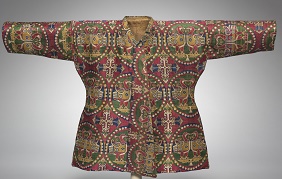
The detail of a woman's robe, cotton and silk velvet, from this Turkmenistan
area, appears in the latest book, Asian Costumes and Textiles, from the Bosphorus
to the Fuji Yama, by Mary Hunt Kahlenberg. Tai Gallery/Textile Arts (website
www.textilearts.com)
will be exhibiting in Sante Fe from December 1st, 2001 to January 31st, 2002
a special exhibition to coincide with the publication of this book.
8
|
Mary Kahlenberg's husband, Robert T. Coffland
is of course the author of the book Contemporary Japanese
Bamboo Arts and wrote the article "Japanese Bamboo
Arts" in our March-April 1999 issue. So it is a coincidence
that Flying Cranes Antiques Limited located at the Manhattan
Art & Antiques Center will be displaying on the same
dates in New York City an exhibition of privately owned
bamboo ikebana baskets and silk obi from Japan (8). I feel
this is indicative of the special interest these days in
these two quite distinctly different Japanese art forms. |
Jean Schaefer of Flying Cranes states, "The firm's clients are constantly
surprised that the obi and baskets in their homes never look the same.
The play of light during evening and daytime hours emphasizes their form,
material and weaves, endless in variety. Representative of the makers'
art, bamboo baskets as living sculpture and hand-woven silk obi, decorative
and elegant, are marvelously effective design elements in either the city
or country and in both contemporary or traditional homes."
In this issue is an advertisement for Trocadero whose relevance of name may
need some explanation. Trocadero in Portuguese means "place of trade" and
this online service according to Mr Livio Cillo, the founder of Trocadero.com, "was
designed to serve the needs of antiques and art merchants and to support their
endeavors. One of its charter members, Ichiban Asian Antiques, contributed
early on to a strong representation of the Asian arts-his own offerings and
those of associates he unselfishly invited to participate. Indeed, the unique
combination of cooperative spirit and friendly competition among Trocadero's
community members contribute greatly to its reputation for fresh selection
and acquisition opportunities."
Mr Cillo also says, "the first ever online auction on Trocadero is anticipated
for November. Offerings will be available from every category represented and
a particularly robust selection of Asian art can be expected-both antique and
vintage, as has been Trocadero's approach."
Readers of this magazine's correspondence section will notice that the interest
in "throne chairs" is continuing. Altfield (
shops@altfield.com.hk)
have put together a fine collection of Chinese chairs for an exhibition which
is sub-titled "Symbols of Status". In Chinese society they say, "seating
arrangements were subject to a hierarchy of rules. The use of a chair with
arms, as opposed to a simple side chair, was a prerogative of rank. Stools
and barrel seats were lower still on the scale. Unlike the West, China did
not develop upholstered seating, although the use of soft cane woven seats
did evolve. For people of rank, highly decorative loose textiles and furs were
often thrown over chairs, and on occasion cushions and rugs were used to soften
hard seats."

9
Pieces of particular interest in the collection on exhibition
include a pair of very fine folding X-leg late 17th/early 18th century
side chairs decorated with black and red lacquer with finely carved detail
(9). Examples such as this belong to the early traditional furniture styles
with strong connections to Tang prototypes.
I do hope by the time of the fourth Asian Art in London, whose activities are
previewed adjoining my September-October 2001 Editorial, things will have settled
down. Now brought to my attention amongst the arts that will be seen there
are recent acquisitions at John Eskenazi Limited, 15 Old Bond Street (email
john.eskenazi@john-eskenazi.com)
from November 5th-23rd and Roger Keverne's winter exhibition of fine and rare
Chinese works of art and ceramics, open on November 8th at 16th Clifford Street
(website
www.keverne.co.uk).
A programme of "Conserving Art-Preserving Culture: Approaches and Methodologies
in the Conservation of Tibetan Art" will also be held on Sunday, November
11th at the Lecture Theatre, Brunei Gallery, School of Oriental & African
Antiques. For booking details and attendance fees refer to Dr Ulrich Pagel,
Department of the Study of Religions, SOAS, Thornhaugh Street, Russell Square,
London WC1H 0XG (email
cths@soas.ac.uk).

10
|
John Eskenazi Limited
announce they will be showing both Indian and Tibetan recent
acquisitions. Most unusual is a Tibetan Milarepa shrine
(10), circa 15th century, height 40 cm, as it is made of
wood and papier-mâché with
painted pigment. |
|
Roger Keverne will be showing over one hundred quality
Chinese works of art including enamels, glass and ceramics,
jades and hardstones, bronzes and organic pieces dating
from the Shang to late Qing. In recognition of Roger's
work on jade and major 1991 publication of that name I
have selected to illustrate from his many fine pieces an
18th century pale green jade wrist rest (11), naturalistically
worked as a section of bamboo, the underside with a phoenix
in relief, length 14.5 cm. A similar rest is in the Palace
Museum, Beijing.
I am happy for a second year to support the Las Vegas
International Antique Fair which will be held at the
Venetian Hotel, Las Vegas, Nevada on December 7th-9th,
2001 with a special preview for the benefit of Nevada
Ballet Theatre on December 6th. Selected exhibitors
come from the West Coast, North America, England and
Europe showing ancient to early 20th century antiques
and collectors items. Selected exhibitors and textiles
also come from "Japantique-Tokyo's finest antique event".
|

11
|
When I received a copy of Collecting Chinese Antiquities
in Hong Kong published by Victor Choi, the owner of Dragon Culture (184 & 231
Hollywood Road, Hong Kong, website
www.dragonculture.com.hk,
Tel: 2545-8098, Fax: 2541-1488), I immediately looked through the handy
pocket guidebook with interest because I have been captivated by the diverse
range of the Neolithic pottery and early earthenware since my first visit
in 1978 to Xi'an in Shaanxi province, and some 30 kilometres east to the
great lattice-arched vaulted building, then still under construction,
which covers the world-famous mausoleum pits of Chin Shi Huang's (born
BC 259, died BC 210) pottery warriors, and life-sized pottery horses with
chariots.
I remember meeting the museum official in charge of the tomb displays, which
is described in my September-October 1978 Editorial, who showed me how the
buried figures had been painted in brilliant polychrome colours, which disappeared
on exposure to air. The figures must have truly appeared splendid when originally
massed in formation.
Dragon Culture's hard cover guidebook, for only US$20 including the mailing
charge, provides sensible advice and relevant information to new collectors.
It contains 314 pages with 230 colour illustrations and readers can order the
book by writing directly to Mr Choi. I am also looking forward to his second
book, Horse for Eternity-Terracotta equestrian tomb sculpture of dynastic China,
scheduled for publication in 2002. I have seen the draft and it is an enlightening
read. Life goes on.