
editorials - July - August
2002 |
 |
|
|
|
|

1 |
I HAVE JUST finished reading Renzo Freschi's
publication, The Art of Gandhara (1), which I have very much
enjoyed, not only for its production, but also for the Foreword,
interesting articles, and useful Bibliography. The publication
provides valuable insights for the Gandharan region 2nd century
AD sculpture in the Los Angeles County Museum of Art, which
is the cover of this July-August 2002 magazine, and indeed
for the Chinese Buddhist sculptural tradition that eventually
followed. |
For comparison the 5th century Northern Qi
Bodhisattva that made the cover for our January-February
2001 issue with three views is illustrated alongside (2). |

2 |
Our tens of thousands of readers and
the many advertisers who help to make the magazine viable
are reminded that Arts of Asia, which I have been publishing
for more than thirty-two years is a respected and recognised
brand name in the field of Asian arts and antiques with
which people around the world are proud to be associated.
As a "sampling",
in the Correspondence section of this number on page 10 are
just a few of the letters of reaction received from a long
list of appropriate recipients, who were sent the March-April
2002 Japanese edition at the request of that issue's main
contributor/compiler, Sir Hugh Cortazzi. It is good to know
of Her Majesty the Empress of Japan's interest in art, and
I am delighted to have been assured, by her Lady-in-waiting,
that Her Majesty will by now have enjoyed reading our "splendid
publication".
Every day I receive enthusiastic and heart-warming letters
from our readers. A brief range of such cuttings from
typically those who subscribe, contribute articles and/or
are Asian art advertisers (in some cases all three!)
are reproduced here: "Every new issue fills me with wonder and joy. It is a miracle
of beauty, art and education; I can hardly believe its splendor, page
after page. How do you do it? No other publication I know produces a
masterpiece 'stained glass window' every two months." Dr Robert
H. Alexander.
"Arts of Asia continues to be a source of artistic and historical
delight and we greet each new arrival with comments of appreciation.
Thank you for the outstanding contribution you are making to more areas
of life than space allows me to cite." Roy and June Honeycutt.
"It continues to be a valuable source of information-Congratulations
on keeping it going and improving through many years." Patricia
Salmon.
"In my opinion Arts of Asia is the premier magazine in its field.
Thanks to you and your staff for providing a publication I eagerly look
forward to receiving every two months. In this field Arts of Asia has
no competitors who approach the quality or content of your publication." Susan
McClure.
"Received the Sept/Oct issue today and want to tell you it is one
of your best. Good lay-out, interesting articles and good professional
reporting about the auctions. Useful and a handsome issue." Sam
Bernstein.
"I received the March/April issue of Arts of Asia. Congratulations!
I am very happy with the way my article has been published, and appreciate
the high quality of the colour reproductions. In several cases I can
compare the printing quality with sales catalogues or books; in all cases
the illustrations in your magazine are superior. In addition, the lay-out
of my paper is really attractive. Thank you for all the work!" Dr
Jan Dees.
There is still time for those overseas readers who receive Arts of
Asia by air to visit the sensational exhibition being held at the Royal
Academy of Arts, London, which has been seen in their Sackler Wing
since April 26th and closes following July 14th. With the title, "Return
of the Buddha-the Qingzhou Discoveries", the exhibition in London
is said to have met with astounding interest and success, though it is
perhaps an exaggeration to state that it has been a "unique opportunity
of showing such sacred works to a western audience". After all,
I would think a "western audience" to still be amongst the
majority of our international readers, and our January-February 2001
issue features "Chinese Buddhist Sculptures-New Discoveries from
Qingzhou, Shandong Province" and "Time and Cause for the Destruction
of the Buddhist Statues from the Site of Longxing Monastery".
These articles were specially commissioned from China's curators. In
Hong Kong we translated them into English, as our support of the exhibition
held at the Hong Kong Museum of Art from January 19th to April 15th,
2001. |

3 |
Dr Stephen Markel of the
Los Angeles County Museum of Art, whose cover article heads
this issue, was writing for Arts of Asia as long ago as
1993. The range of Indian art and the subjects he has covered
for this magazine and others are considerable. He is seen
at the entrance to the South and Southeast Asian art gallery
(3) and asks me to mention the exhibition "The Circle of Bliss: Buddhist
Meditational Art" which will premier there on October
5th, 2003. He says: "The guest curator is Professor
John Huntington. He and his staff are writing the catalogue,
which is still being edited." |
While still on the subject
of Buddhist art, I am prompted to mention that readers
will find Achinto Sen-Gupta's article on "Portable Buddhist Shrines" unusual.
I like the idea of sleeping on Buddhist shrines as headrests,
following the practice of enlightened monks on their return
journeys from India to China. Surely during those days some
devotees were also wearing Zi beads, and I would be interested
to hear from our readers of any sculpture or paintings which
suggest this. It must be said, though, Zi bead wearers even
today are reluctant to show their protective amulets to others.
However, it is worth confirming what Achinto records: "Portable
shrines owe their origin to amulets, which are of great antiquity
in India and western Asia." To illustrate the point
are amulets from Bharhut (2nd century BC) taken from The
Stupa of Bharhut by Alexander Cunningham, London, 1879
(4). |

4 |
While absorbed in writing
this Editorial I received an email from Monica Cleckler
of PO Box 560, Hunt, Texas 78024, USA ( cleck3@ktc.com). She asks for my advice. "I was
told that Jamey D. Allen is an expert and has submitted
for publication an article on dzi beads that will be presented
in your May/June issue. Do you have any information about
this or when to expect this publication? Have there been
any previous articles about dzi beads that you could tell
me about? Or if you know an expert who can help me, I certainly
would appreciate it if you could let me know."
Well here it is on pages 72-91, Jamey D. Allen's comprehensive
article, beautifully illustrated and designed, for
which I must give him full credit. His article should
be read with utmost care to understand his classifications
and recognise Himalayan so-called "pure" Zi
beads from other groups. For those who want to see other
examples of Zi beads I recommend the book The Gzi Beads
of Tibet by Lin Tung-Kuang. I have met the Taiwanese
author a few times and to my knowledge he has travelled
widely through Tibet and especially Lhasa to study
and buy beads. His book was first published in Chinese
and it was at my suggestion that he had it translated
into English. |

5 |
I was present
at the May 7th, 2002 sale at Sotheby's in Hong Kong of
the exquisite Yongzheng mark and period (1723-1735) famille-rose "peach" vase
that made a sensational world auction record for Qing (1644-1911).
This event up to the fall of the final hammer is fully
reported in the Saleroom News in this issue on pages 113-117,
Lot 532. After registering in my mind the astounding record
price, I put aside several days to researching more intimate
details for my international readers. In fact immediately
after the sale I had approached the buyer, the elegant
Mrs Alice Cheng (5), treasurer of the Chinese Chamber of
Commerce, agent for Ericsson in China for several years,
and sister of the famous Hong Kong dealer Robert Chang.
She has many kinds of business in China and is reputed
to be an enormously rich and powerful woman on the mainland.
She told me she was very happy with the purchase of the
Yongzheng vase. She also said once she made up her mind
to buy the piece she was therefore willing to pay a high
price for it. |
According to Henry Howard-Sneyd,
Managing Director of Sotheby's China and Southeast Asia,
at least six people were willing to pay up to HK$30 million
for the "peach" vase
belonging to the Hon. Ogden R. Reid, United States Ambassador
to Israel from 1959-1961. He inherited the work of art
from his mother and used the vase as a lamp stand in his
New York home. Hong Kong dealer William Chak bidding for
his mainland Chinese client went up to HK$36 million but
this was not enough. Mrs Alice Cheng paid HK$41.5 million
including the buyer's premium.
Commenting on the auction results Henry Howard-Sneyd
said, "Following
the dramatic price of HK$41.5 million for the 'Reid' vase, Sotheby's reclaimed
the world record price for any piece of Qing porcelain. This pre-eminence
in Chinese porcelain is emphasised by the fact that we hold the clean sweep
of world record prices in ceramics for every major dynasty from the Tang
to the Qing including that for the most expensive piece of Chinese ceramic
ever sold at auction, HK$44.4 million for the Jiajing, wucai 'fish' jar,
sold in October 2000.
"Although the record price for the 'Reid' vase was a tremendous
highlight of the auction, almost every other major piece decorated
in famille-rose enamels sold significantly above the pre-sale estimate.
Lot 533, a basin of immaculate quality, was even unmarked, but doubled
its low estimate to sell for a record price for unmarked porcelain
at HK$4.54 million. This reflects the new dynamic in the market increasingly
evident over the past two years, whereby the taste and collecting habits
of newer collectors, many from mainland China, drives that particular
area of the market strongly upwards. Arguably similar trends were seen
historically as the Japanese collectors became so strong in the late
1980s and pieces of Japanese taste shot to the top of the records.
"Despite the strength of Chinese buyers, there are always other
collectors in this most international of markets, who are prepared
to fight hard for desirable lots, and therefore never let a piece get away
cheaply."
After the auction William Chak told me Ambassador Reid, who was in
Hong Kong with his family to attend the sale, visited his gallery at
76-78 Hollywood Road and thanked him for participating at Sotheby's.
They had a picture taken together.
Richard Marchant is a world expert on Chinese ceramics and is particularly
knowledgeable on Qing porcelain. When I asked him about the record
sale of the Yongzheng vase he said, "It was not a surprise for me as
I anticipated a high price. It is one of the most important Qing Imperial
pieces coming on the market. When it was shown in New York prior to the
sale I handled and studied the vase for fifteen minutes. I truly enjoyed
this absolutely wonderful piece and indeed I had no doubt about the price
at all. It makes good sense that Mrs Alice Cheng bought it. She has the
best advice in her brother Robert." Richard added, "She certainly
has the funds as her husband is Graham Cheng of the Amoy [soy sauce]
canning family." The name of her father-in-law, Cheng Te-k'un,
is very famous as an academic scholar and author.
London dealer David Priestley, a former Chinese ceramics specialist
for Sotheby's in London, also believes "the price for that piece
is not out of line for Qing Imperial works of art". He now feels,
at least in the medium term, rare Chinese Imperial works of art will
continue to fetch high prices.
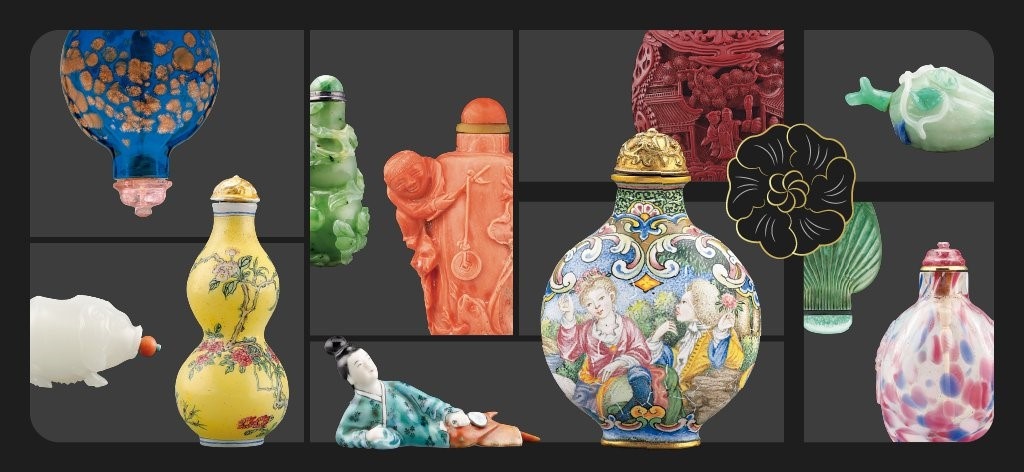
As a snuff bottle collector myself I can hardly wait to see in print
our special snuff bottle issue for the September-October 2002 magazine.
This has been designed specifically to support a highly important and
topical exhibition and a convention in this region, "Inkplay in
Microcosm"-an exhibition of inside-painted snuff bottles opening
at the Art Museum, The Chinese University of Hong Kong on October 8th,
2002, and The International Chinese Snuff Bottle Society's Singapore
Convention, October 22nd-25th, 2002. Already the lead snuff bottle article, "Treasured
Snuff Bottles of Mr and Mrs Denis Low" written by Robert Kleiner,
is designed for the issue with fifty outstanding examples, many of the
bottles seen in two or even three views and with their seals. With all
the articles in full colour I can guarantee this will be a remarkable "volume" which
collectors will keep in their libraries for constant reference.
|
Southeast Asian influence on the
arts becomes more prominent. Mr Nguyen Hong Hai, Consul General
of Vietnam in Hong Kong, is seen at the Sotheby's preview
with Henry Howard-Sneyd (6). |

6 |

7 |
Next I illustrate Le Hamac (The Hammock) (7),
a painting of Vietnamese women by Joseph Inguimberty (France,
1896-1971), which sold at the Christie's in Hong Kong inaugural
sale of Southeast Asian and 20th Century Indian Pictures
on April 28th, 2002. I am posed rather appropriately into
this idealised romantic setting, which painted in 1938 recalls
my earliest youth. Hedda and Frank Lutz who are notable collectors
in Asian art, including Chinese snuff bottles, purchased
this large oil on canvas at the very reasonable price of
HK$776,750. |

8 |
Finally I am happy to announce
that Christian Deydier (8), Secrétaire General de l'Association des
Spécialistes en Art Asiatique, has recently been elected
Président de Syndicat National des Antiquaires in
France. Specialist in Chinese epigraphy and Chinese bronzes
he is the author of many books, including Les Bronzes Chinois,
Office du livre, 1980 and Archaic Chinese Bronzes-Xia & Shang,
Arhis, Paris, 1995. With his friend Professor Han Wei,
Deputy to the 9th National People's Congress and a world-known
specialist in Chinese gold and silverware, their latest
publication Ancient Chinese Gold, was published by Les
Editions d'Art et d'Histoire, Arhis in October 2001 ( editionsarhis@minitel.net). |
|
|
|