
editorials - September
- October 2002 |
 |
|
|
|
|
I WOULD LIKE to commence
my Editorial in this important snuff bottle issue by thanking
those outstanding contributing collectors, writers and
specialist snuff bottle dealers for their generous support
in taking part. As I forecast in my July-August 2002 Editorial
the issue has been designed to specifically coincide with
a topical exhibition of inside-painted snuff bottles opening
at the Art Museum, The Chinese University of Hong Kong
on October 19th, 2002, and The International Chinese Snuff
Bottle Society's Singapore Convention, October 22nd-25th,
2002. This present edition with its erudite articles and
beautiful illustrations from many areas of snuff bottle
collecting surely deserves its place in snuff bottle collectors'
libraries where Arts of Asia numbers are most likely
to be found featuring articles by prestigious names
in this field, such as Michael Kaynes (September-October
1971), Hugh Moss (July-August 1972), Bob Stevens (July-August
1973), Edward O'Dell / John Ford / A. Stempel (November-December
1976), Wang Xisan (September-October 1984), Mary and
George Bloch (September-October 1990), Joe Grimberg
/ Patrick Kwok (November-December 1993), J & J / Clare
(Lawrence) Chu (November-December 1998).
As one of the earliest surviving Honorary Members of
The International Chinese Snuff Bottle Society my own
snuff bottle collection is also not unknown and has
been written about several times including most recently
by expert author Robert Kleiner. Recognised as one
of the world's major authorities on snuff bottles,
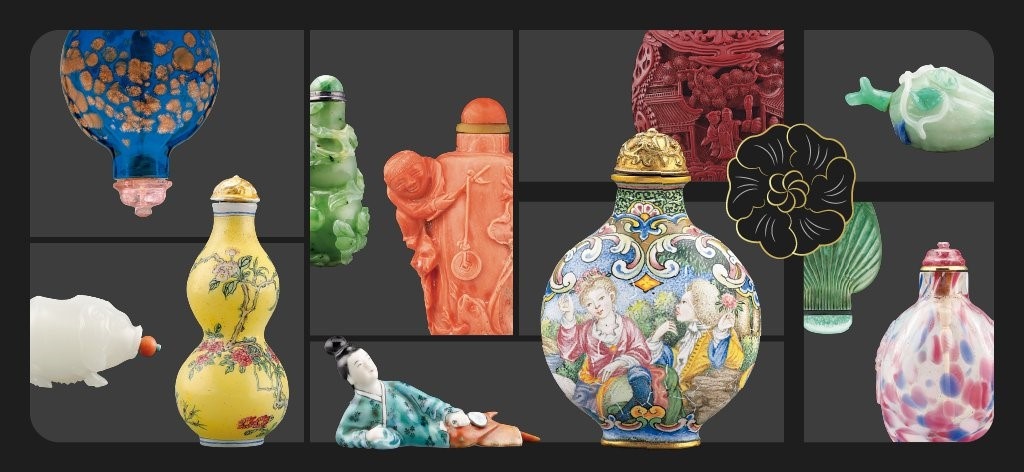
Robert now describes and illustrates fifty examples,
mainly from "the
realms of the Imperial" of the "Treasured Snuff
Bottles from the collection of Mr and Mrs Denis Low".
The strengths of this article more than justify its position
as the first of the snuff bottle features in the magazine.
And it surely confirms "the increasing respect with
which these miniature treasures of the Qing dynasty are
now being held by all who are interested in the unparalleled
treasure trove of art created under the patronage of
the successive emperors of the Qing, between 1644-1911".
|

1 |
Denis Low (1) is seen in my office, where we
are standing together before a historic painting of children
presenting flowers to the late Chairman Mao Zedong (a painting
which in its day travelled to official exhibitions in many
parts of China). The main purpose of his short visit to Hong
Kong in the first week of July was to put the final touches
to his coming book More Treasures from the Sanctum of Enlightened
Respect. I am also happy he found time to answer a few of
my questions for our international readers. |
A retired Singapore real-estate
consultant and now private venture capitalist, Denis graduated
from Singapore University with a degree in estate management
from the faculty of architecture. A fifth generation Singaporean,
he and his charming wife Seok Eng's families came from
Swatow, South China. They work together in their business,
Low & Low
Holdings Pte Ltd, and have two daughters, ages eleven and
twenty-two.
Denis Low has always been a passionate collector. He
first became interested in snuff bottles when he walked
into Patrick Kwok's gallery in Singapore together with
S.L. Tan to see a Wang Xisan snuff bottle. He ended
up buying four snuff bottles including three by Wang Xisan.
That was in 1979. Subsequently he started buying from
other galleries in Singapore and at Sotheby's auctions
in London, Hong Kong and New York. He remembers meeting
Robert Kleiner at one of the Tresors art fairs that
used to be held in Singapore in the early 1990s. The Singapore
snuff bottle collector Joe Grimberg also introduced
him to Hugh Moss. He had read Hugh's books and was surprised
to find he was so young. At Tresors he also met Robert
Hall but only started buying from him when his own
collecting started to get serious later in the 1990s.
His collection now numbers some 900 snuff bottles. "Some
snuff bottles" he says, "are easy to like",
such as glass. But he is returning to pieces with a
good feel in the hand-tactile pieces such as jade and
stone, even rock crystal and agate, pieces which have
weight. Amber he finds is too light and does not give
a solid enough feel. But amazingly he says he does
not look at his bottles too often. He collects in many
fields, including cars, Cartier jewellery (panthers
and other cats), watches and mystery clocks.
His advice for collectors is to always buy the best
you can afford or buy what you like, and do not think
about the investment. "I tell everyone that I am
passionate not about the snuff bottles but the chase
in collecting". He is a relative newcomer in the
past ten years to collecting snuff bottles intensively
compared to some of the late names in this world I
have known, such as Edward O'Dell, Bob C. Stevens and
Mr and Mrs A. Stempel.
Humphrey K. F. Hui, who writes in this issue of our
magazine on "Meetings in Support of Inkplay in Microcosm
with Masters Wang Xisan and Lu Shouben", is a
well-known collector of Chinese snuff bottles which
have been exhibited in Hong Kong, Australia and the
United States. He bought the first few bottles as early
as in l978, however it was only after a lapse of ten
years that he began collecting seriously. He first
became known to me in the collecting world through
his joint book An Imperial Tradition, 1994, published
in Hong Kong by Humphrey K. F. Hui and Christopher
C. H. Sin, and designed with Rosanne Chan, which catalogue
their exhibition held first at the Asian Art Museum
of San Francisco (December 8th, 1994-February 5th,
1995) and then at Phoenix Art Museum (February 15th,
1995-April 15th, 1995).
Humphrey has also exhibited in many and various collective
exhibitions, such as A Congregation of Snuff Bottle
Connoisseurs" an
exhibition of Chinese snuff bottles held at The Tsui
Museum of Art in 1996. This was intended to reflect
the international image of Hong Kong before its return
to China in July 1997. The exhibition was initiated
and coordinated by Christopher C. H. Sin.
An Imperial theme continues in Humphrey's The Imperial
Connection: Court Related Chinese Snuff Bottles, 1998,
published by the Art Museum, The Chinese University
of Hong Kong. Again, rather more than a catalogue,
a hard cover book in English and Chinese, it has a
Preface by Mayching Kao (Director, Art Museum, The
Chinese University of Hong Kong) and articles by Xia
Gengqi and Zhang Rong (Palace Museum, Beijing) who
summarise the varieties of snuff bottles in The Humphrey
K. F. Hui Collection, such as Glass (Monochrome, Overlay,
Stir Glass, Carved Glass, Enamels on Glass); Nephrite;
Quartz and Stones (Agate, Chalcedony, Quartz, Turquoise,
Shale, Tianhuang); Porcelain; Organic (Gourd, Bamboo
Veneer, Cinnabar on Lacquer, Jet); Metal (Cloisonné Enamels,
Enamels on Copper).
In addition it has a final article by Peter Y. K. Lam,
in his inimitable scholarly fashion, "Studio Marks
in Imperial and Court Related Snuff Bottles",
which recounts, with site plans and relevant Chinese
seal marks, what is known and to what can be attributed
(and/or can not be attributed) various hall marks:
Guyuexuan (Ancient Moon Pavilion); Jiale Tang (Hall
of Fine Happiness); Yijin Zhai (The Jin Bequest Studio);
Yangzheng Shuwu (Study for the Nourishment of Integrity);
Shende Tang (Hall of Prudent Virtue); Xingyoubeng Tang
(Hall of Perseverance); Tuisi Tang (Hall of Retiring
for Contemplation).
Since World War Two a revived international interest
in snuff bottle collecting came as a result of the publication
by Charles E. Tuttle Company (Rutland, Vermont and Tokyo,
Japan) of Chinese Snuff Bottles-The Adventures and Studies
of a Collector, 1960 by Lilla S. Perry, and the enthusiasm
of a small band of American collectors and collector-dealers,
such as Gertrude Stuart. About this time I also began
collecting.
Internationally interest was reinforced as a result
of the comprehensive book by the late Bob C. Stevens,
The Collector's Book of Snuff Bottles, First Edition,
1976, Weatherhill (New York, Tokyo). At that time Bob
Stevens was living in Tokyo, and Hong Kong was on his
itinerary when for expatriate visa reasons he was required
every six months to leave Japan. On part of these world
vacations he was accompanied by other friends and knowledgeable
snuff bottle experts, such as Hugh Moss. Thereby expanding
his considerable knowledge, snuff bottle references and
photographs for his book.
Although I have devoted much of my Editorial to the
inside-painting area of snuff bottles, I would especially
like to focus here for our worldwide readers' information
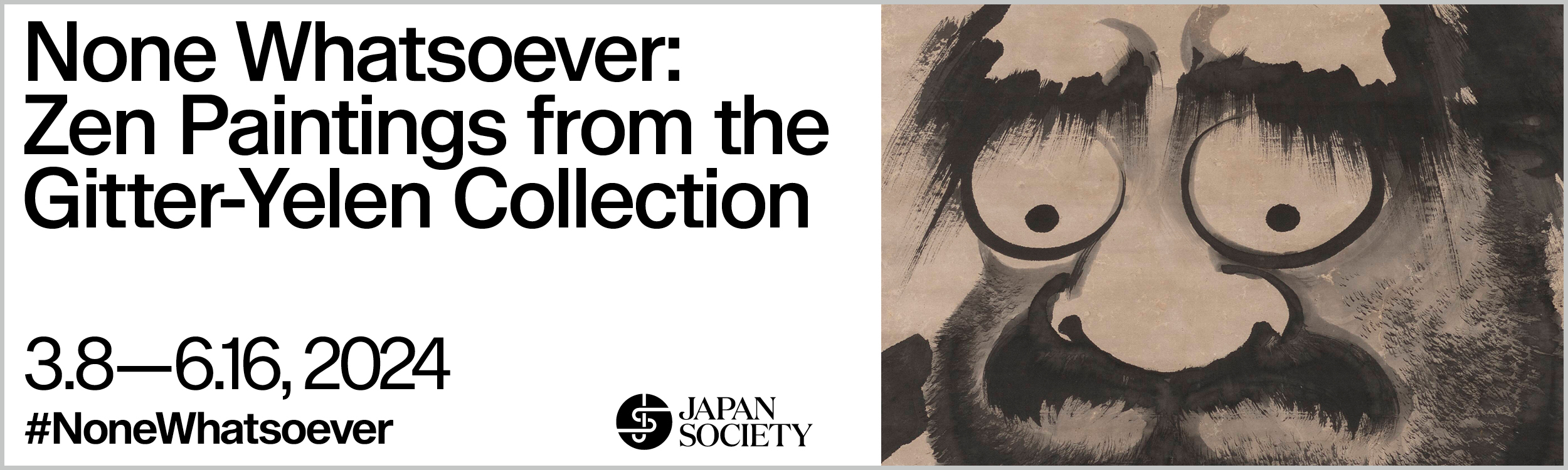
on this issue's lead article by curator Lisa Rotondo-McCord, "17th-20th
Century Japanese Painting from the Gitter-Yelen Collection
at the New Orleans Museum of Art". Already Japanese
art has received much interest from our readers this
year as a result of the March-April 2002 issue which
covered Japanese exhibitions held in London. The Gitter-Yelen
Collection travels during the next two years in America
where it will be seen from August 31st-October 26th,
2002 at the New Orleans Museum of Art; March 10th-June
15th, 2003 at the Seattle Art Museum; and at the Japan
Society, New York, from March 10th-June 15th, 2004.
Appropriately, it is an American collection devoted
primarily to Japanese painting of the Edo period (1615-1868)
as well as paintings by Japanese artists up to and including
the first half of the 20th century. As Lisa Rotundo-McCord's
descriptive and clearly presented article notes, these
paintings by twenty-four different artists have been
brought together by the discerning eye of careful and
perceptive collectors and illuminate many of the major
artistic currents. The exhibition of nearly one hundred
and forty scrolls, screens, handscrolls and fans surely
deserves your visit.
We have been following the progress of the painter and
poet Chan Ky-Yut with great interest, not least because
born in China in 1940 he was for the most part educated
in Hong Kong where he held his first exhibition in 1968.
More exhibitions followed in Hong Kong in the next two
years and in 1999 he held a solo exhibition of twenty-five
years of his work at the Baur Collections, Geneva, Switzerland.
|
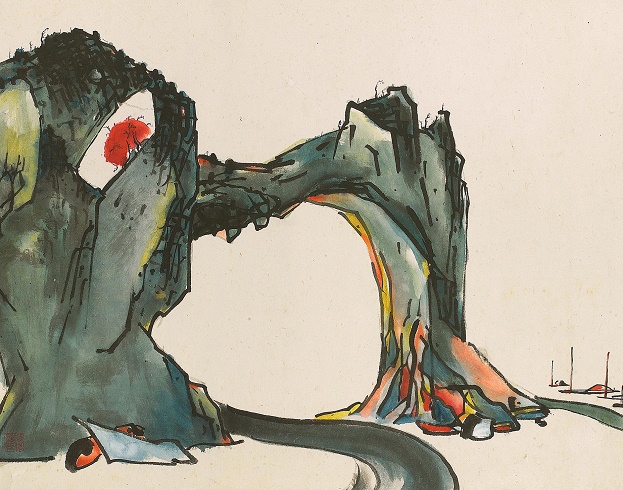
Fundamentally an action painter using the calligraphic
skills which he inherited and developed in China and Hong
Kong, his paintings express a joyful spirit through their
lively use of colour and can be subject to a variety of interpretations.
The colophons down the sides, from his own brush, in Chinese
characters in the main state where and when the works are
painted (2), though occasionally his own poems accompany
his paintings, or he paints to accompany the poems of others. |

2 |
Chan Ky-Yut's work is on
exhibit now at the T. T. Tsui Gallery of the Victoria & Albert Museum in
London, where it opened in May and will be celebrated in
a special way this September. According to Ming Wilson, the
museum's Exhibition Officer, "His paintings, especially
the large-scale ones, can lead viewers into a dream world
where everything is bright and full of vitality. Looking
at Full Moon Forever Dreaming, the special commission for
the V & A, what the eyes see are from a void, motion
and stillness, colours and black ink, and what the mind experiences
are energy, transcendence and total freedom." The famous
London museum has also commissioned Chan to create a book
of his poetry and watercolours.
To celebrate her twenty-five years in business, Chinese
costume and textile specialist Linda Wrigglesworth will
be presenting "Creative Momentum", an exhibition
of twenty-five Imperial Chinese dragon roundels of
the 17th-19th centuries integrated with the contemporary
Tibetan calligraphic art of their resident artist Tashi
Mannox. The exhibition will be held simultaneously
on two sites in London, the Linda Wrigglesworth Gallery
at 34 Brook Street, and the White Room of The Metropolitan
Hotel in Old Park Lane. It opens on 4th November and
runs until 14th December, 2002.
|

3 |
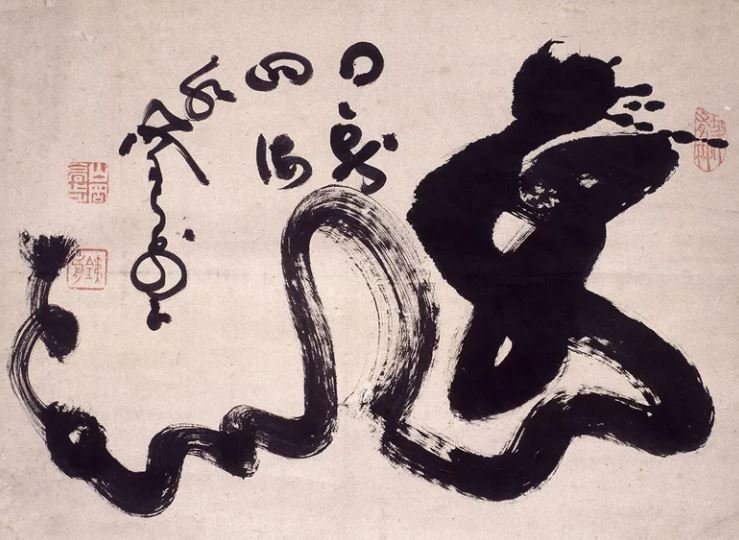
The art of Tashi Mannox,
who trained for sixteen years as a Tibetan monk, embodies
primarily the spirit of Tibetan iconography. "Creative Momentum" fuses
Tashi's contemporary expression of creative energy with
the traditional Imperial insignia made in silk. Seen here
in the background is his calligraphic work Self Arising,
ink on paper mounted on board (3). |
|
In the foreground are two 19th century roundels both with
front-facing, five-clawed Imperial dragons. The roundel
on the left is a kesi silk tapestry from an Imperial consort's
semi-formal court robe decorated with eight roundels (1821-1850).
The blue satin roundel on the right is from an Imperial
nobleman's surcoat (1850-1870). |
According to Myrna Myers, "Ornament and
costumes are two complementary aspects of a single theme:
the importance of dress and adornment in marking degrees
of power and prestige in Chinese society." From September
19th-October 19th Myrna Myers will present in her gallery
at 11 Rue de Beaune, 75005 Paris, France, "The Language
of Adornment", an exhibition of an unusual ensemble
of Chinese hardstone ornaments from the Neolithic period
to the Qing dynasty. Of special interest is a rare group
of jades, rock crystal and amber of the Liao dynasty, which
ruled parts of China from the 10th-12th century. Illustrated
is a pair of Liao dynasty monkeys riding horses carved
in rock crystal (top pair) (4). |

4 |
These ornaments are rebuses
or compositions with Chinese alternative meanings. In this
case suggesting, "May
you rapidly be ennobled." From the same Liao dynasty
period Myrna Myers is showing a pair of small green jade
containers in the form of swans, with incised gold inlay
and gold caps; and a pair of rock crystals with gold inlay
carved as makara water creatures, derived from Indian mythology,
with scaly bodies and elephant-trunk, wide-mouth monster
heads (bottom pair). |

5 |
An earlier example of the
paired animal theme comes from the exhibition that John
Eskenazi will be presenting at The International Fine Art & Antique
Dealers' Show at the Seventh Regiment Armory in New York
which is open to the public from October 18th-24th, 2002.
But in this reddish brown sandstone frieze from Madhya
Pradesh (Central India), dating from the 3rd century, a
lion is pursued by a hunting dog (5).
"In Iran the lion symbolised royal power and the Kushans, familiar with
Iranian ideas, felt the lion to be an appropriate symbol when first asserting
their rule over northwestern India. To the indigenous population of India the
lion represented the religious strength of Buddhism so when the Kushans adopted
Buddhist beliefs, the use of the lion motif increased. The dog on the frieze
is similar to those depicted on Assyrian friezes, its heavy strength in direct
contrast with the sinuous, elegant lion."
To complete my final page of Editorial I return to the
interview form which I acquired as a young journalist
student at Mundelein College for Women in Chicago and
honed on television exposures, such as "Meet the
Press" in America and Hong Kong. Perhaps I should
declare here my own interests as a foreign correspondent
for many years after marriage in 1959 which brought
me to live overseas. My purpose in founding Arts of
Asia in 1970 was to promote understanding, goodwill
and friendship between people across the world. So
I am delighted that art now flourishes in China and
that collecting is accepted as a support of historical
knowledge and culture and a benefit of wealth. |

6 |
Seen at my office on July 10th this year is Mrs Yannan
Wang who is President of China Guardian Auctions Co., Ltd
(2-603 Henderson Center, 18 Jianguomennei St, Beijing, 100005
China) (6). In the course of our interview we discussed the
most recent collecting and auctioneering trends. |
Tuyet Nguyet-As President of China Guardian
Auctions Co., Ltd what are the changes you have seen over
the last ten years in the PRC in the collecting and auctioneering
of works of art in a public and open manner in relation to
the established collections and the general public?
Yannan Wang-Over the last ten years the auctions have
really modernised the sale of works of art in the PRC.
We can say the appearance of auctions is a landmark for
the sale of works of art in the PRC. Through the open
and public auctions, collectors can have a greater chance
to learn and appreciate art. It is also more convenient
for them to buy their favourite art.
What do you forecast for the future and in particular
the impact on people in Asia and the West, and your own
collectors who are increasingly bidding on very expensive
works of art?
I think the PRC is becoming the selling market centre
for Chinese works of art. It is a good place to buy and
sell art. With steady economic development, the government
has relaxed the policy on the protection of art. I am
very optimistic about the future of the Chinese market
for trading art.
In the wider way how do you see the impact on the ordinary
people and their lives
Do you see more Chinese
works of art in homes? Do you see the expanding of
decorative works such as woodcuts, paper cuttings and
modern Chinese paintings, including works in oil, in
people's homes?
In recent years Chinese residents have very much improved
their living conditions. Most families like to decorate
their homes (paintings on walls, works of art in cabinets).
With better economic situation, some people are actively
choosing their favourite works of art for their homes.
Of course, due to the different tastes or economic situation
of each family, the decorations would include woodcuts,
paper cuttings, oil paintings, etc.
What are the areas of collecting in China that differ
from the outside? How do collectors actually display
their antiques? In fact do they display their antiques
in their own home or do they consider them cultural treasures
to be carefully stored?
Chinese collectors still mainly collect Chinese paintings
and calligraphy. This has been the traditional way of
thinking and also there are many Chinese paintings and
calligraphy in the market, which helps to make this the
most popular field of collecting. I think this differs
from Western collectors. In recent years works of art
including rare books, ceramics and modern art has also
quickly developed in the China art market.
In China many people like to display their art collections
in their companies or homes. But many collectors who
consider their pieces cultural treasures would store
them in a very proper way and would take them out to
show their friends to appreciate and enjoy.
Where can you source top-quality works of arts such
as Chinese porcelains and early paintings, which are
fresh to the market? As we know established dealers and
collectors are willing to pay very high prices for the
pieces.
We are stationed in China so we source mostly within
our country. We have started to try as much as possible
to source from overseas.
How do you plan to auction the middle-market items,
such as jade carving and Chinese modern painting for
a wider audience?
We have major sales twice a year and since 1994 also
hold minor ones every two months for lower value items.
These have been very successful and there is a wonderful
atmosphere at such events. At these minor auctions we
sell paintings and calligraphy, antiques, watches, cameras,
jade and jewellery. This allows more people to collect
in different price ranges and categories. They are happy
with the auctions and support them. In the first sales
there were 300 lots (US$70,00 total value), which have
increased over the last eight years to 2000 lots (US$850,000
total value).
Are you optimistic about the future and can you describe
your plans? I was very impressed to know that you recently
sold a very important Chinese Song handscroll for over
US$3 million. I understand the seller and buyer were
both from America. Will you be able to continue to receive
and sell important works of art to satisfy the increasing
demand of Chinese collectors living in China?
I am very optimistic about the future. The 2002 spring
auction for the Rare Birds Painted from Life handscroll,
attributed to Emperor Hui Zong (1082-1135) of the Song
dynasty, was very successful. It encourages us. I think
the Chinese works of art market is very good and we will
work harder to satisfy the increasing needs of Chinese
collectors. Our next auction is on November 3rd, with
two days of previews on November 1st and 2nd.
|
|
|
|