
editorials - January -
February 2003 |
 |
|
|
|
|

1 |
HEADING THIS Editorial is
an artist's rendering of the completed new Asian Art Museum
in San Francisco (1). It shows the building's main entrance
and the Fulton Street façade from the same angle as is seen on page 43 in
Thomas Christensen's major article, when it was the city's
main library which opened to the public in 1917. I would
also like to thank here Dr Emily Sano, Director of the new
Asian Art Museum, for the article/introduction she has specially
written for our readers, with the subtitle "An Institution
Transformed". I feel the site photographs, pages 34-35,
showing the construction and adaptation in progress are
most appropriate. Married to a practising architect since
forty-three years, I know the pressures that arise when
a building project nears completion and I would like to
thank all those concerned in the museum for preparing their
articles on the chosen subjects. |
Incidentally, Thomas Christensen
has been responsible for servicing and getting to us so
efficiently the historical photographs, museum plans and
the photographs by Kaz Tsuruta. As well as writing the
first full article ("The New
Asian Art Museum in the Civic Center San Francisco"),
he has also provided the following information which should
be useful as a quick reference to getting to the museum:
"Overlooking Civic Center Plaza, the Asian Art
Museum is located at 200 Larkin Street, between Fulton
and McAllister Streets. Beginning March 20th, 2003,
the museum will be open Tuesday through Sunday from 10:00
am to 5:00 pm, with extended evening hours until 9:00
pm every Thursday. Admission is US$10 for adults, US$7
for seniors, US$6 for youth 12-17, and free for children
under 12. Admission includes a complimentary audio
tour of the museum's collection galleries. The location
offers easy access via BART, MUNI, Sam Trans, Golden Gate
Transit, and the Bay Bridge. Parking is available in the
nearby Civic Center Garage and other paid parking facilities
in the neighborhood. For more information, please call
(415) 581-3500 or visit www.asianart.org."
Of coming exhibitions, and looking a year ahead, I
especially look forward to the museum's "The Arts of Korea's
Goryeo Dynasty", which I see from the article
by Kumja Paik Kim, in this issue, dates from 918-1392.
An exhibition of the work of six contemporary Korean
artists will be shown at the same time. These two exhibitions
are scheduled to run from October 18th, 2003-January
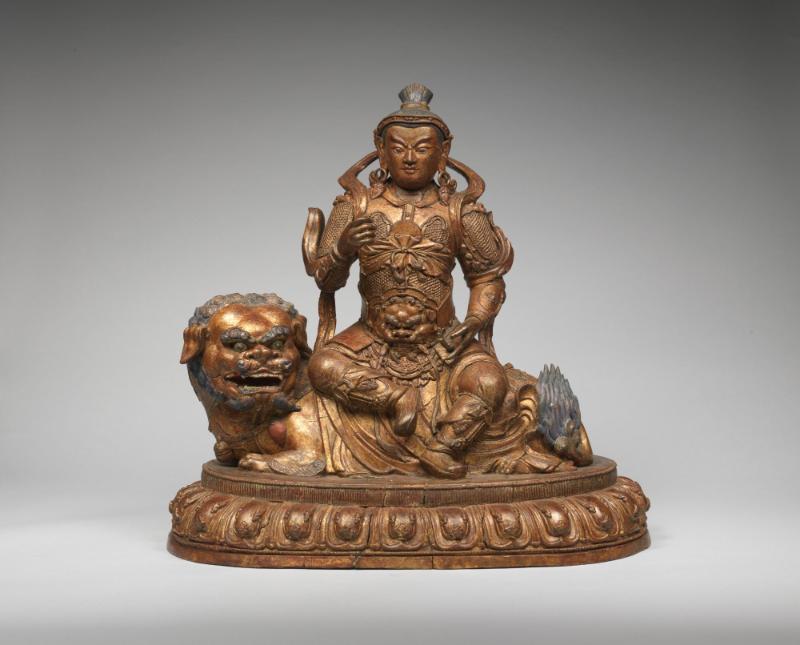
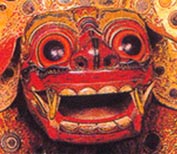
11th, 2004. A Korean guardian, incidentally, has also
been chosen for our cover, because of the protection
we hope it will offer our readers through the 2003
year.
It is always a pleasure to return to Hong Kong (since
my last Editorial I have been to Singapore, Beijing
and Manila) and in this issue we do so with an article
by Rose Wing Chong Lee of the Hong Kong Museum of Art
on "Chinese
Jade and Gold". This inaugural exhibition of the
second Chinese Antiquities Gallery which opened in
August 2002, is truly outstanding. I have made several
visits already because of my own strong interests in
both Chinese subjects. It is good to hear from Rose
that the exhibition is likely to run on in the Hong
Kong gallery for the whole of 2003, and I would like
to encourage all visitors from the mainland and overseas
to see it when they have the chance. |

2 |
The Hong Kong
Art Craft Merchants Association Ltd was founded in 1968
and today they number 300 members. I am seen photographed
with a prominent group of fifteen at their headquarters
(2). To help promote tourism in Hong Kong, they launched
their first Art and Antique Festival, from October 1st-31st,
2002 and I was happy to accept their invitation to be present
at the opening. The activities took place in a Hong Kong area, familiar
to art collectors and art dealers, which is also of considerable historical
interest: Man Mo Temple, Hollywood Road, Upper Lascar Row, Lok Ku Road
and Ladder Street. Stretching down to Queen's Road Central and the
business centre of Hong Kong, the festival took in Wyndham
Street, Lyndhurst Terrace and Wellington Street, which
are also homes to many antique and art dealer galleries
well known to our local readers. |

3 |
| A ribbon-cutting ceremony was
held outside the Man Mo Temple, accompanied by lion dances.
Seen jointly cutting the ribbon in typical Hong Kong style
are, from the left, Mr Mason Hung of Hong Kong Tourism Board,
Mr Kam Nai-wai JP and Mr Wu Chor-nam JP, of Central and Western
district councils respectively, Mrs Stanley Ho (who as well
as being wife of the famous Hong Kong property tycoon and
Macau gambling kingpin, has her own gallery), Dr Chow Kwen-lim
and Mr James Wang of Hong Kong Art Craft Merchants Association
(3). |

4 |
Wang Xisan, the inside-painting
master, made a trip to the Art Museum of The Chinese University
of Hong Kong, from the mainland, to officiate at the opening
ceremony of the exhibition on October 18th of "Inkplay in Microcosm-Chinese
Inside-painted Snuff Bottles, The Humphrey K.F. Hui Collection".
(For information on this notable collection, and the "Treasured
Snuff Bottles of Mr and Mrs Denis Low", refer back two
issues to the September-October 2002 magazine.) Amongst the
many devotees present on this occasion were (from the left
of our photograph) Peter Y.K. Lam, Director of the Art Museum,
who wrote also for the September-October issue on "Inside-painted
snuff bottles by Gan Xuan", Berthe and John Ford (President,
The International Chinese Snuff Bottle Society), myself,
Helen and Humphrey Hui (4). |

5 |
The International Chinese Snuff Bottle Society
Singapore Convention 2002, held at the Ritz-Carlton Millennia
Singapore, October 22nd-25th, was voted by the more than
100 participants to be one of the most successful and rewarding
yet. Many of our friends had passed through Hong Kong on
their way to Singapore, and I am seen here at a magazine
and book display in the convention's Singapore dealer's room,
with Christopher Sin, designer and publisher Rosanne Chan
(CA Design), John and Berthe Ford, Humphrey Hui, and Rosanne's
brother Tony (5). |

6 |
Robert Kleiner, the snuff
bottle expert and considerable author on the subject was
euphoric. "Exhibitions
outstanding
the convention is very well organised
warm
hospitality by the local collectors
a very nice crowd
enthusiastic,
serious convention members
business was good as well
one
of the best conventions I have ever attended since 1974" are
among the things he has enthused to me. It is remarkable
the first convention took place in 1969, New York City,
that long ago.
No doubt the Singaporeans were very generous. A first-day dinner was hosted
by Joe Grimberg, Quentin Loh Sze On and Gary Nolan Davis. Seen before the
next day lunch is organising committee member Mayling Yeo (far left) (6)
with hosts Vanessa F. Holden, Lai Choi Kuen and Patrick Kwok. |
The second-day dinner was hosted by Denis Low
and his wife Seok Eng. That dinner was prefaced by a viewing
in the Low home of their fantastic Collection (Part 1) named
from the Sanctum of Enlightened Respect. Mary and George
Bloch, up to now undoubtedly the foremost and most widely
published snuff bottle collectors, were full of compliments
and praise of the Low bottles.
Though I was only in Singapore a few days, I was able
to see all four major exhibitions. These were Denis Low's
Collection (Part 2) at the new Asian Civilisations Museum,
Empress Place; the local collectors' exhibition, travelling
by coach to the National University of Singapore Museum;
the modern bottles organised by the Chinatown Snuff Bottle
Society with inside-painted demonstration by Liu Shouben;
and the collection of Joseph Grimberg at the Regent Hotel.
In earlier days, Patrick K.M. Kwok, Director at the Kwok
Gallery, Singapore, had written for us on "The Joe Grimberg Collection
of Snuff Bottles" (Arts of Asia, November-December 1993, pages 92-97).
Since then this collection has intentionally been limited by its owner
to 200 select examples with upgrading when occasions arise. My most admired
of his bottles is the triple-overlay glass example which is indeed unique
and beautiful. |
|
As is said at the beginning to the foreword
of the catalogue of the Chinese Snuff Bottles exhibition
(7), which was held at the NUS Museums, Singapore, from
October 23rd-November 10th, 2002: "The collecting
of snuff bottles in Singapore has advanced enormously in
the past decade, inspired by the on-going formation of
the two world class collections, being assembled by Joe
Grimberg and Denis Low." A neat 73-page catalogue,
with laminated cover, slightly smaller in format than our
own magazine was published in support of the exhibition,
and I see seven lenders are listed, with their initials
appended to the descriptions of each bottle. Cataloguing
in category order and numbers of examples are: glass, 77;
enamels, 20; nephrite and jadeite, 53; rock crystal, chalcedony
and hard stones, 52; organic and others, 17; porcelain
18; inside-painted, 32. Suggesting that glass, nephrite
and jadeite, rock crystal, chalcedony and hard stones are
Singapore's priorities. |

7 |
I found this exhibition,
with its catalogue, a very good effort, and I note the
help that is credited to Vanessa F. Holden. She contributed
an article, "The
Origin of Snuff", assisted and advised on the production
of the catalogue and wrote the entries. The foreword is
by Robert Kleiner, and the names of the seven lenders are
appended to an acknowledgement page as follows: Quentin
Loh Sze On, Gary Nolan Davis, Richard Baey, Tan Suan Phon,
Chee Huei Leng, Steven Cheong and David P.L. Chan.
|

8 |
You may remember Mrs Yannan Wang, President
of China Guardian Auctions Co., Ltd, who visited our offices
in Hong Kong and is pictured being interviewed in my September-October
2002 Editorial (page 10). It was my pleasure to return that
visit in Beijing at her China Guardian autumn 2002 auctions
in early November. Seen here (8), she is seated at the centre
of the auctioneer's table with a bouquet of flowers and at
the podium senior auctioneer Mr Gao is conducting the sale.
Highlights of the afternoon on Sunday, November 3rd was a
pair of 17th century huanghuali compound wardrobe cabinets
which made an astonishing RMB9,438,000 (estimate RMB4.5-5.5
million), equivalent to US$1.27 million (9).
|

9 |
According to Mrs Wang, the auction house was
founded in May 1993 and their first auction was held in spring
1994. Since 2001 each of their departments now have been
allocated two specialists. They can also call on advisors
such as Mr Qi Gong, a ninety-three years old gentleman who
is expert in classical paintings, while other experts specialise
on certain name artists. For instance Fu Baoshi came from
Nanjing and there are a group of Nanjing Museum experts who
also can be of help. |

10 |
The Qi Baishi hanging scroll, titled Shrimp
and a Bird and dated 1929, fetched RMB682,000 (estimate RMB350,000-450,000)
(10). The painting was purchased by a successful Beijing
artist still in his forties who said when he was very young
he studied and grew up with a print of this very painting.
It was published in collections of Qi Baishi's works in 1963
in Beijing and 1967 in Taiwan.
Hot on the heals of China Guardian are Huachen Auctions, whose principals
of the two houses I should stress are both on good terms. Huachen's president
Mr Gan Xuejun, who was formerly working with China Guardian Auctions Co.,
Ltd, says he has his own thoughts on the art market and is always looking
for a new opportunity to accomplish his ideas. His auction house is under
the umbrella of the Ministry of Culture, however it is neither state owned
nor an organisation of the government. Rather, main investors are China
Cultural International Exhibition Centre, China International Cultural
Travel Service and China Sight Cultural Development Company Limited. |

11 |

12 |
In the picture, Mr Gan is shown on the left.
On the right is Mr Zhao Yiming, a director and manager of
Chinese paintings and calligraphy (11). Mr Gan, who says
he is very lucky to have a good team to work with, also introduced
me to two others of his staff who were formerly of China
Guardian: Mr Dai Dai, director and manager of Chinese porcelain
and works of art and Ms Wei Lijun, director and vice president
(12).
Formed in 1997, Huachen Auctions offers objects for sale
from collections of private individuals from China, Hong
Kong, Taiwan and Europe. Pieces coming from outside China
receive an official export permit, which means they can
be taken out of China again. At Huachen Auctions the commissions
are 10 per cent both for buyers and for sellers. Most Chinese
national museums, it seems, are now also buying from auctions
with monies coming from various sources. The government
appears to be more open about this than before, as they
realise their museums also need help in forming worthwhile
collections. |

13 |
Following our trip to Beijing
our executive editor Robin Markbreiter went on to "Asian Art in London".
He was very active and in five days attended over forty gallery
and museum exhibitions. One of the first events he covered
was the November 8th lecture at Bonhams, "Collecting
in Context: Lord Cunliffe, Chinese Ceramics and English Taste,
1700-1960" by Colin Sheaf, International Head of Asian
Art. Colin is seen in the left of Robin's picture together
with Lady and Lord Cunliffe, son of the original collector
the 2nd Baron Cunliffe (13). Colin's report on the highly
successful Cunliffe sale appears on our pages 112-113.
Also that evening the "Asian Art in London" launch party, a champagne
reception, was held at the Sir Joseph Hotung Gallery of Oriental Art at
the British Museum. The organisers were thrilled all 500 tickets (at £50
per ticket) were sold for the party. Many guests enjoyed the venue and
prefer the cocktail party format rather than a formal sit-down gathering.
They can mingle in the gallery and catch up with old friends. This year,
however, it was noticeable that not as many overseas collectors and dealers
were present at the launch party. |

14 |

15 |
Welcome speeches were given
by "Asian
Art in London" Chairman, Giuseppe Eskenazi, and snuff
bottle expert Robert Hall (14), one of the Directors of
the Steering Committee. For the second year AXA Art Insurance
Limited was the lead sponsor and presented the AXA Art
Award to celebrate the craftsmanship and beauty of three-dimensional
and two-dimensional Asian art. Theresa McCullough's impressive
late 9th century buff sandstone Vishnu from Uttar Pradesh,
northern India, won the three-dimensional award (15), and
Simon Ray won the two-dimensional award for an Indian red
peacock banner, circa 1775. The two winners with three
of the four runners up were photographed at the British
Museum-Alastair Gibson for Sotheby's, Gregg Baker, Simon
Ray, Theresa McCullough and Linda Wrigglesworth (16). Also
pictured at the launch party are Giuseppe Eskenazi, Stuart
Marchant, John Guy, Deputy Head, Indian and Southeast Asian
Department at the Victoria and Albert Museum, Mee Seen
Loong of Sotheby's and David Priestley (17). On the following
three evenings dealer and auction house openings were held
at Kensington Church Street, St James', and Mayfair. These
openings were very lively and are a great way to encourage
more people and collectors to go into the galleries to
view. |

16 |

17 |

18 |
Before returning to Hong
Kong Robin made a special trip to Milan to see Renzo Freschi
and his exhibition of "Sculptures from India",
formed over ten years, at his attractive gallery located
in the city's most fashionable central district (Via Gesu,
17, 20121 Milano, Italy, email: renzofreschi@libero.it).
Renzo is an acknowledged expert in Indian, Tibetan and
Himalayan art and this was an opportunity for Robin under
Renzo's tutelage to learn what to look for in assessing
stone sculpture. In the picture (18) Renzo is posed next
to his Uttar Pradesh, Mathura, 2nd/3rd century sandstone
yakshi or "female
nature-spirit" feeding a parrot from her right breast.
A glimpse is also seen of his very stylish Milan gallery,
which compliments his person. Renzo and his charming wife,
the editor of an Italian magazine, were extremely helpful
to Robin, and they welcome guests to the gallery. |

19 |
A visit to the new gallery of Carlton Rochell
Ltd (41 East 57th Street, 4th Floor, NY 10022, email: info@carltonrochell.com)
is most definitely on my visiting list for when I am next
in New York. Before then, I am delighted to report that Carlton
Rochell (19), seen greeting with a handshake Jodie Eastman
and Richard Marks, opened the new gallery with a lively cocktail
party on October 17th, 2002. The mix of friends and important
guests included museum directors such as Brooklyn's Amy Poster
and expert dealers such as Robert Ellsworth. Seen here, at
the centre of the photograph (20), is Carlton's father-in-law,
famous actor Charlton Heston. Left is Carlton Rochell's wife,
Holly Heston Rochell, right is Rebecca Kry. |

20
|

21 |
Carlton Rochell, of course,
was for a long time a valued senior member of Sotheby's
American staff, relied on for his specialist knowledge
of Indian and Southeast Asian art, having established their
first full-time department in 1985. His aim he states as
president of his own company is "to work closely with collectors and institutions
to further broaden this relatively undeveloped sector of
the Asian art market". I am confident he will succeed
in this aim helped by Jeanne de Guardiola Callanan, the
gallery director, who was joined at the party by her banker
husband William Callanan (21). At Sotheby's, Jeanne and
Carlton were a team working together from 1994-2000, and
an important American private collection is already forecast
for an inaugural exhibition in March. They assured me they
would present the most beautiful and impressive works of
art in their field for display in their gallery.
During the last year we have made tremendous efforts
visiting many countries to promote and widen the Arts
of Asia readership as well as to collect great unpublished
materials for our editorial contents in future issues.
I can truly report that we have won hundreds of new
subscribers and I strongly feel that as we create more
readers they will eventually turn to be serious collectors
of Asian art. This certainly helps the Asian art market
and our advertising clients of leading art galleries and
auction houses.
As a reminder I am publishing at the foot of the adjoining
column the Chinese New Year greetings frame from the
April 14th, 1860 Illustrated London News. It is a time
of giving presents and exchanging good wishes cards.
Mine go to all our supporters for the very happiest,
prosperous and peaceful Year of the Goat which commences
on January 31st, 2003. Finally I wish our international
readers further learning and enjoyment from their studies
through our magazine so they can continue to collect
with confidence. I forecast this will be a good time
to reassess and upgrade their collections. Kung Hei
Fat Choi! |
|
|
|