
editorials - March - April
2003 |
 |
|
|
|
|
IN PRESENTING this exceptionally
well-researched special textiles issue on the Asian collection
in the Victoria and Albert Museum (whose entrance is shown
above) (1), I can do no better than first referring our
international readers to the carefully written Introduction
on pages 44-45 by Mark Jones, Director of the V&A, London. In his first few
sentences, the Director explains that the collections published
in our magazine represent the national collection of the
UK and that they were brought together in 2002 "under
our newly reconfigured curatorial team, the Asian Department". |

1 |
His record takes the reader
from the founding of the V&A in 1852 through to the creation of a Far Eastern
Department in 1970. It is interesting to note, "There
was a genuine intellectual curiosity in other cultures which
motivated the more enlightened members of the East India
Company avidly to collect Indian manuscripts and artefacts
in the latter part of the 18th century
[while] the
first items of Chinese textile and dress to enter the V&A
were acquired in 1863". In 1865 the V&A received
its first group of Japanese textiles in the form of a gift
from Queen Victoria, and the museum purchased widely from
Japanese displays at international exhibitions. Today contemporary
textiles are not forgotten, for the V&A is actively
collecting these items across the range of its collections. |
I wish to thank most warmly
John Guy (2), Senior Curator of Indian and Southeast Asian
Art at the V&A,
and the supporting team of V&A major curators and researchers
for their outstanding work in contributing their articles
in the course of the last year and a half. John Guy was very
enthusiastic for my proposal when he joined us for lunch
at my Hong Kong offices on Saturday, July 21st, 2001. Following
his return to London, by November 12th, 2001 he had mapped
out a list of authors and provisional titles. He had mentioned
that there was no comprehensive catalogue of these areas
of the V&A collections, and on seeing the proofs of
the issue the museum ordered six hundred magazines for
their bookshop. I am delighted that Arts of Asia magazine
will be used as a catalogue by London visitors, in addition
to our normal worldwide readers. |

2 |
My first trip to Beijing was in the winter
of 1965, a year before the Cultural Revolution. It was remarkable
on my most recent visit to find the great changes that have
taken place since then. I was pleased to see that while the
city is certainly now a modern one, its historic character
in many areas still remains. I jotted down for our readers
the following positive thoughts: the city is definitely prosperous;
the people are smartly dressed in Western fashions and are
smiling and appear happier, relaxed, confident and more approachable
than before; the streets are beautifully tree-lined making
it pleasant for strolling; it looks much cleaner these days;
the new highways allow for efficient traffic flow and it
takes only some thirty minutes by taxi from airport to city
centre. These are good signs for the future Beijing 2008
Olympics, but there is still time for further improvements.
In my view Beijing ranks as the most organised city in Asia. |

3 |
On the following page of this Editorial I am
first seen in Beijing with Mr Jiang Ying Chun (3), Chief
Curator of the Poly Art Museum, which is very centrally located
in the Poly Theatre building, 2/F, Poly Plaza, 14 Dongzhimen
Nandajie, Dongcheng, Beijing, China, Tel: 86-10-65003334-646,
Fax: 86-10-65010263. We are posed for the photograph between
the famous bronze monkey and tiger heads from the old Summer
Palace garden. These were bought from Sotheby's and Christie's
Hong Kong auctions in May 2000, and were reported in my July-August
2000 Editorial. |
The
Poly Group, a huge international corporation, invited me
to a private personal viewing in their museum when normally
it would have been closed. Their galleries are housed in
their Poly Theatre complex, and on adjoining upper floors
is their own hotel. The tallest building in Guangzhou is
another enterprise by Poly, as also is Shanghai's Stock
Exchange building. Three of the group's companies are publicly
listed in China. The museum, established in October 1999,
opened with an inaugural exhibition of its most distinguished
bronzes the next spring. The rescue and return to China
of the bronze Yuan Ming Yuan palace animal heads received
unanimous praise and support from all sections of Chinese
society. The more than 170 bronzes on exhibition come from
a total bronze collection of close to double that number.
They were acquired in Hong Kong, Macau, Japan, Europe and
America; some examples also came from Taiwan.
The President of the Poly Art Museum is Mr He Ping,
a party congress member married to the youngest daughter
of the late Chinese leader Deng Xiaoping, and its conception,
in conjunction with a government committee dates back
more than seven years. Its superlative collections of
great artistic and/or historical value are presently
documented in three separate Chinese language beautifully
illustrated hard-cover books with simple Chinese and
English captioning. The fuller texts, however, are in
Chinese only. In chronological order these books are
Selected Bronzes in the Collection of the Poly Art Museum
(1999, 396 pages), Selected Works of Sculpture in the
Poly Art Museum (2000, 236 pages), and Selected Bronzes
in the Collection of the Poly Art Museum (2001, 261 pages).
The size of each book is 29 by 22 centimetres. I strongly
recommend these books for the libraries of our serious
collectors of Chinese works of art as pictorially alone
they are great assets for learning.
A new museum building designed by leading American architects
with over two thousand square metres of floor space is
planned to open either in 2004 or 2005. The much larger
areas available and higher ceilings for display will
allow some massive pieces to be shown which are now in
storage. Today the museum numbers seven full-time specialised
staff members concentrating mainly on early Chinese bronzes
(Shang to Tang) and stone sculpture (Northern Wei to
Tang). This limiting decision was made because of the
difficulty of forming an equally fantastic collection
of calligraphy and painting, the very best pieces of
such Chinese art being already in the Palace Museum in
Beijing and the Shanghai Museum of Art. The main aim
is to collect and buy back historic sculptures from abroad
and to show people within China their country's finest
treasures.
Last December my son Robin and I were invited to attend
at the Guangzhou Museum of Art in China the exhibition "Past & Present" from
the National Museum of Australia. The exhibition was
part of the commemoration of the 30th anniversary of
the establishment of diplomatic relations between Australia
and the People's Republic of China, 1972-2002, and ran
until February 9th, 2003.
|

4 |

5 |
It is unusual to see Australian Aboriginal
and Torres Strait Islander Peoples art illustrated in Arts
of Asia as were displayed in the Guangzhou Museum of Art's
main exhibition hall (4). Robin's second photograph catches,
from the left, Australian Consul General to Guangzhou John
Courtney, Australian Senator Kemp, Guangzhou Vice-Governor
Li Lanfang and Vice-Mayor Chen Chuanyu just after they had
jointly cut the ribbon (5). |
The exhibition
introduced visitors to "nine diverse communities, their lives and beliefs,
their distinctive stories and art". I was told 250
tribal groups exist in Australia and their identity is
based on their language, country and ceremony. I was introduced
to Vice-Governor Li Lanfang and presented her with the
two latest issues of Arts of Asia magazine, which she says
she sees in the homes of her friends. I wish to congratulate
Jenny Courtney and her husband, the Australian Consul General,
for their successful presentation of the aboriginal art.
My only regret is that there could have been more exhibits
to fill the hall, especially with those earlier nostalgic
works from renowned aboriginal artists. |
For several years Sandra
Whitman, the San Francisco based antique Chinese carpet
specialist, has wanted to mount an exhibition of geometric-design
carpets and textiles. Now, in cooperation with London textile
dealer Linda Wrigglesworth, their exhibition "Glorious Geometrics" explores
the role of geometric forms (6) in East Asian carpet and
textile design over the past 500 years. The exhibition
will be held from March 10th through March 22nd, 2003 at
Sandra Whitman's gallery at 361 Oak Street, San Francisco,
CA 94102, USA, Tel: 415-437-2402, Fax: 415-861-0432. In
honour of the reopening of the San Francisco Asian Art
Museum, Sandra and Linda as well as Marsha Vargas, Managing
Director of Xanadu Gallery (140 Maiden Lane, San Francisco,
CA 94108, Tel: 415-392-9999, Fax: 415-984-5856), will host
opening receptions on March 18th.
|

6 |

7 |
As part of Xanadu Gallery's
exhibition "Buddhist
Images through the Ages" which will run until April
26th, Marsha writes, "We will be exhibiting approximately
70 statues, 15 thangkas and 10 Tibetan manuscript covers.
The Buddhist sculpture will range from a wonderful 2nd-3rd
century Gandharan stone bodhisattva to 11th century Pala
and Kashmiri bronzes, Himalayan deities, as well as Southeast
Asian and Chinese sculpture including two 6th century stone
Buddhas."(7) |
Carlton Rochell is pleased
to announce the inaugural exhibition of "Faces of Tibet: The Wesley
and Carolyn Halpert Collection" at his gallery in
the Fuller Building, 41 East 57th Street, New York, NY
10022, Tel: 212-759-7600, Fax: 212-759, 7601. The show,
which coincides with the International Asian Art Fair,
the Arts of Pacific Asia Show and the Asia Week auctions,
will open from March 25th to April 5th, 2003. The gallery
will display and offer for sale some seventy works from
the celebrated Halpert Collection, in addition to other
works of art from India, Thailand, Cambodia, Indonesia,
Tibet and Nepal. A favourite piece in Dr Halpert's collection
is a bronze figure of Mahasiddha Jalendra (8) dating from
the 16th century. The acrobatic Jalendra stands in a yogic
posture atop a prostrate victim on a lotus throne, with
his left leg raised and bent upwards so that its foot is
resting above his left shoulder. |

8 |

9
|
J.J. Lally & Co. is also
located in the Fuller Building in New York City and for
their special exhibition from March 24th to April 12th,
2003 will bring together ancient Chinese masterpieces of
bronze, gold, gilded bronze and gold-inlaid bronze. The
sculptural and ornamental works were made for luxury and
religious purposes dating from the beginning of the Bronze
Age in China in the Shang dynasty through the Han dynasty.
One of the earliest bronzes in the show is a 13th century
BC tripod food vessel (li) (9) made for symbolic offerings
to ancestors. The elaborate monster mask (taotie) designs
cast in intaglio on the sides of the vessel retain the
original black pigment infill, giving sharp definition
against the bright green patina of the metal. Ancient Chinese
gold objects rarely survive and one of the rarest and most
exquisite objects in the exhibition is a cast gold pendant
overlaid in gold wire with an auspicious inscription spelled
out in stylised Chinese characters. The pendant can be
dated to the brief Xin dynasty, AD 9-23. |
Gisèle Croës will exhibit her collection
of "Outstanding Bronze from Dian Kingdom and Early Chinese
Vessels" from March 24th to April 2nd, 2003 at Danese
Gallery, 41 East 57th Street, New York, NY 10022, Tel: 212-223-2227,
Fax: 212-605-1016. Visitors will have the chance to see around
forty rigorously selected Chinese objects including impressively
cast Shang and Western Zhou bronze containers made for sacred
ceremonies. Gisèle will also present stone sculptures
from the Six Dynasties period and earthenware of the Tang
period such as her fabulously sculpted camel and cameleer
(10). |

10 |

11
|
Eskenazi, one of London's leading dealers in
Oriental art, will feature for sale eighteen Chinese works
of art from the world-renowned Stoclet Collection at PaceWildenstein,
32 East 57th Street, New York, NY 10022, Tel: 212-421-3292,
Fax: 212-421-0835, from March 25th to April 5th, 2003. The
major works of art comprise archaic inlaid and gilt bronzes,
stone sculpture and jade and ivory carvings spanning nearly
3000 years. Illustrated is a large Sui dynasty crisply carved
limestone head of a bodhisattva (11). The deity wears an
expression of calm benevolence, his head adorned with an
elaborate crown. |

12
|
James Hennessy of Oriental
Arts UK has written to me to say they are delighted to
be exhibiting for the third consecutive year at the Maxwell
Davidson Gallery in the Fuller Building from March 24th
through April 2nd, 2003. "We
feel that the New York Asian Art Week is the most important
venue available for European dealers to show their strength,
professionalism and expertise in Asian art to the American
audience. This year we are exhibiting a wide-ranging selection
of pieces dating from the Han through to the late Qing dynasty.
Various mediums include porcelains, jades and lacquer to
appeal to the broader American tastes. We look forward to
seeing all our friends from the world of Asian art during
this exciting week in New York." Selected for my Editorial
is a large imperial yellow-glazed bowl, diameter 18.6 cm
and Zhengde mark and of the period (12). |
Annie Yau Gallery
Ltd has asked me to announce their show "Chinese Porcelain & Jade
5000 Years" will be held at their gallery (173 West
88th Street, Suite A, New York, NY 10024, Tel: 212-721-4658,
Fax: 212: 501-7354) from March 15th through March 29th, 2003.
The exhibition will feature quality Chinese objects including
Song and earlier ceramics, ancient jades, early bronzes,
as well as twenty Chinese paintings (Song to contemporary).
From the over forty-five ceramics from the Neolithic to the
Qing period I illustrate a finely potted pure white "Xing
Yao" vase with foliate mouth from the Tang dynasty
(13). |

13 |

14 |
John Eskenazi will again
be exhibiting a selection of pieces at the eighth International
Asian Art Fair at The Seventh Regiment Armory, Park Avenue
at 67th Street, New York, NY 10021, from March 28th through
April 2nd, 2003. Among the beautiful works on offer will
be a spectacular Nepalese early 16th century gilt copper
image of Syamatara, the Green Tara (14), one of the most
popular goddesses in Nepal for both Buddhists and Hindus.
She is primarily a saviour, Tara meaning "to cross over" reflecting
the fact that she is believed to guide the spirits of the
dead across the void to their next incarnation on earth.
|
Leon and Karen Wender of
China 2000 Fine Arts will present original Chinese political
paintings from the 1950s and 1960s at their stand at The
International Asian Art Fair. They will also have Chinese
paintings by Shao Yixuan (1886-1954), Lin Gang (born 1925)
and Zhu Qizhan (1892-1996), glassworks by Arlan Huang (born
1948) as well as a collection of scholar objects. Shown
here is Threeway Alliance Committee Meeting (15), oil on
canvas, 110 by 153.2 cm. At their gallery (5 East 57th
Street, New York, NY 10022, Tel: 212-588-1198, Fax: 212-588-1182)
Leon and Karen will hold the exhibition "The
Paper Chase: Creations in Paper by Contemporary Chinese Artists" from
March 26th to April 26th, 2003 featuring works by Lin Yan,
Wei Jia, Hou Yuanji and Zeng Xiaojun. |

15 |
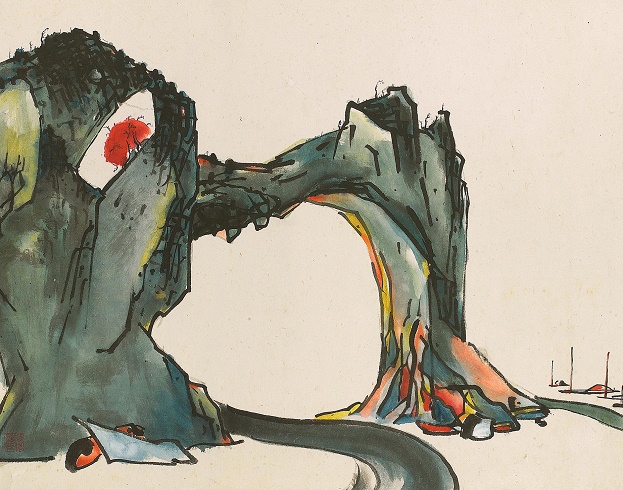
We
have had so much support for this special issue on Asian
textiles in the Victoria and Albert Museum, London, that
we have not at the final stage been able to include at
least a page of letters from readers. However, there is
just space to include in this Editorial a short extract
from a longer letter I have received from Monte James,
the curator of the exhibition "Dong Kingman:
Watercolor Master" held in Hong Kong in the Exhibition
Galleries 1-3, Hong Kong Central Library from December
28th to January 26th.
"It is an extraordinary opportunity to work with
such a great body of work by a painter like the late
Dong Kingman. He was one of those rare artists who,
by remaining true to his own instincts and creativity, influenced
art and history in his own lifetime. Just as in his
early career Kingman enjoyed the support of friends and patrons
like C.V. Starr, so we could not have undertaken this
tribute without the support of the Starr Foundation
which carries on his dedication to education and cultural exchange
in his name. And our sincere gratitude to the other
supporters, lenders, museums, international media and Kingman family
who joined us to present this exhibition." |

16 |
At the opening ceremony Monte James is seen
introducing special guests Dong Kingman Jr., Edmund Tse (Senior
Vice Chairman and Co-Chief Operating Officer of American
International Group and Board of Directors of the Starr Foundation),
David Miller (US Consulate Public Affairs Officer), and Michael
Mak (Assistant Director, Leisure and Cultural Services Department,
Hong Kong) (16). |
Finally I would like to take this opportunity
to wish our international readers and advertisers a very
happy and prosperous Chinese New Year. I look forward to
meeting you in New York during Asia Week at the many exciting
gallery exhibitions, Christie's and Sotheby's auctions, and
the two major art fairs-The International Asian Art Fair
(March 28th to April 2nd, The Seventh Regiment Armory, Park
Avenue at 67th Street) and the Arts of Pacific Asia Show
(March 27th to 30th, The Gramercy Park Armory, Lexington
Avenue at 26th Street). |
|
|
|