
editorials - May - June
2003 |
 |
|
|
|
|
|
DR MADELEINE
KIM, who writes the first article (seen on our cover) (1)
for this Korea and Japan issue, has recently pointed out
to me that her first contribution to Arts of Asia was as
long ago as 1981. That was in the July-August edition,
when she reviewed for our readers' pleasure the late G.St.G.M.
Gompertz's scholarly Chinese Celadon Wares (Faber & Faber,
Ltd, London, 2nd revised edition, 1980). Gompertz, however,
is still best remembered for his book Korean Celadon (1963),
also published by Faber. |
|
Interest in Korea and its civilisation
was seen earlier in the United States in 1957 with an important
exhibition. This was expanded twenty years later with a
tour of seven major American museums and the exhibition "5000 Years
of Korean Art". (See the cover of the January-February
1980 issue where it appears as "Panorama of Korean
Art" for an article by Patricia Salmon on pages 86-98.)
(2)
|

2 |

3
|
It was already apparent to us last year
that Korea is once again high on the listing of the international
scene. For instance, for our recent special museum issue
of January-February 2003, "The New Asian Art Museum in the Civic Center
San Francisco", a Korean subject was chosen (3). So
for our current magazine we invited Dr Kim to write the
article on her husband's generous donation of the Rhee
Byung-Chang Collection of Korean Ceramics and the Annex
Building located in the Museum of Oriental Ceramics, Osaka,
in which it is housed. Long-time contributor Sir Hugh Cortazzi,
former British Ambassador to Japan 1980-1984 and a well-known
scholar and author in his own right, follows with descriptions
and illustrations of thirty superb examples courtesy of
the museum.
|
|
We return to Korean furniture (it also
appeared in coverage in our November-December 1979 and
July-August 1981 (4) editions) with "Traditional Korean Furniture from
the Ewha Womans University Art Museum, Seoul" by Yuling
Huang and Sunwha Rha. However this is the first time that
it has been covered for us by appropriate Asian writers
with drawings of the room arrangements and a large group
of the actual trimming and carving tools.
|

4 |

5 |
Before moving
on further I would like to mention how I have personally
very much enjoyed the article by Barry Till, Michiko Wargentyne
and Judith Patt, "From
Geisha to Diva: The Kimono of Ichimaru". Though it is
said "Throughout her life, her sisters regularly visited
her to request loans and she generously gave them money,
near the end of her life her housekeeper maid-servant walked
off with much of her fortune, thought to be as much as 80
million yen. Ichimaru did, however, leave behind a tremendous
legacy to the Japanese music industry and her triumph over
adversity, to become an outstanding diva, is indeed a remarkable
story." Her collection of kimono was donated to the
Art Gallery of Greater Victoria by her friend and confidant
Mrs Fumi Suzuki of Tokyo.
Those readers who subscribed to Arts of Asia last year
will remember the excellent preview pictures of the
Asian Civilisations Museum's Empress Place Singapore premises
in the November-December 2002 issue. But the main entrance,
the oldest part of the original building, was not at
that time seen as it was still under restoration. However,
for the official opening ceremonies on March 1st, 2003
we were able to photograph the entrance with its Asian
Civilisations Museum name up high under the roof eaves
and the piers of its entrance arches painted in gallery
identifying bands of colours (5).
|

6 |
|
The next picture shows the official opening on March 1st,
2003 with Guest-of-Honour Prime Minister Goh Chok Tong
beating the drum (6). He is supported by (on the left)
Dr James Khoo, Chairman, Asian Civilisations Museum, Professor
Tommy Koh, Chairman National Heritage Board, Mr David Lim,
Acting Minister, Ministry of Information, Communications
and The Arts, and (on the right) Brigadier General (NS)
George Yeo, Minister for Trade and Industry, and Dr Kenson
Kwok, Director of the Asian Civilisations Museum. Amongst
the estimated 2000 guests who were present in the museum's
marquee and public spaces I am seen here with Mr K.Y. Ng,
Mr Patrick Kwok, Mr Erik Lim and Mr V. Vijay (7). A welcome
speech was made by Professor Tommy Koh and the relevant
parts are reproduced here:
|

7 |
|
"The content of the Asian Civilisations
Museum reflects who we are and where we came from. From
the founding of modern Singapore to this day, we are the
product of the confluence of the Chinese, Malay, Indian,
Islamic and Western civilisations. Culturally, a Singaporean
is part Chinese, part Malay, part Indian, part East and
part West. The culture of Singapore is therefore a fusion
of these ancestral civilisations. The idea of the Asian
Civilisations Museum came from Minister George Yeo. He
reasoned that such a museum would help us to know ourselves
and help us to plug into an international cultural network.
Faithful to his vision, this museum has galleries devoted
to the civilisations of Southeast Asia, China, South Asia
and West Asia. The Asian Civilisations Museum has another
salience. It is important for Singaporeans to understand
Southeast Asia because we are an integral part of the
region and the region is part of us. It is important for
Singaporeans to understand China and India because they
are rising economies and great civilisations from which
we have much to learn. In the post-9/11 world, it is imperative
for all of us to have a better understanding of Islam,
the Islamic civilisation and its roots in Asia. The opening
of the Asian Civilisations Museum is a milestone in Singapore's
quest to deepen our cultural roots and broaden our cultural
sensibilities on the basis of who we are and where we
are in Asia and the world.
"This museum is a happy example of partnership:
partnership between the government, the business community
and philanthropic individuals; partnership between Singapore
and the governments of India and the Netherlands; and
partnership between the ACM and private collectors and the Tareq Rajab
Museum of Kuwait. The Singapore government has contributed
S$79 million towards the physical infrastructure and
S$16 million towards the museum's collection. We have raised
S$17 million in private donations to the museum's collection.
In addition, we have secured the long term loans of objects
worth S$132 million and another S$124 million in short-term
loans.
|

8 |
"Today, I want to acknowledge
our special thanks to the Government of India for the long-term
loan of archeological and museum artefacts; to the Tareq
Rajab Museum of Kuwait for the loan of part of its wonderful
collection of Islamic art and to the National Museum of Ethnology
of the Netherlands for the long-term loan of a number of
ancient bronzes.
"I would also like to acknowledge the generosity
of a number of Singapore individuals and institutions.
The Kwek family [who are seen with the Prime Minister]
(8) has donated S$2.8 million to our building fund. We
are very pleased to name our China gallery after the
patriarch of the Kwek family, Mr Kwek Hong Png. Mr Edmond
Chin has donated his magnificent collection of Southeast
Asian jewellery to the museum. We have named one of the
three Southeast Asian galleries after Edmond's proud
parents, Mary and Philbert Chin. We have named our auditorium
as the Ngee Ann Auditorium in recognition of a generous
donation of S$1.5 million from the Ngee Ann Development
Pte Ltd. We are also greatly indebted to the long-standing
support and generosity of the Tan Tze Chor family, the
Singapore Leisure Industries, the Shaw Foundation, the
Lee Foundation, Andy Ng and Pamela Hickley
."
|
Following
Tommy Koh's speech the official Guest-of-Honour Prime Minister
Goh Chok Tong made presentations to three major benefactors
of the Empress Place Building Project: Hong Leong Foundation,
Mr Edmond Chin and Ngee Ann Development Pte Ltd.
Readers will have noticed that since our November-December
2002 issue Chubb has been advertising on the inside
back cover of our magazine. I have received some information
from Jennifer Scally of the Personal Insurance Department
of Chubb Hong Kong who has been responsible for the
launch of Masterpiece. Ms Scally, Assistant Vice President,
Personal Insurance Manager, Federal Insurance Company
(a member insurer of Chubb Group of Insurance Companies),
has provided answers to my queries of the relevance of
Masterpiece to our readers who are collectors.
She explains, "Chubb Masterpiece is a comprehensive
insurance policy for homes, cars, boats, valuable possessions
and collections, and personal liability. It has been
especially created for those with significant assets
to protect and who demand the reassurance of superior
levels of coverage and service. The coverage and service
that it offers are unique in the industry and are beyond
our customers' expectations."
It is appropriate that while our May-June 2003 issue
has been under production the Chubb Group of Insurance
Companies has sponsored an exhibition at the Hong Kong
University Museum and Art Gallery titled, "Ancient
Taoist Art from Shanxi Province". This coincides
with a Hong Kong Taoist Festival and the 50th Anniversary
of the Museum's opening. I will make a point of visiting
the exhibition at 94 Bonham Road, Hong Kong once this
issue has successfully gone to press and I am relieved
from my publishing pressures.
|

9 |
I surely do wish to learn more about Taoism and this would
seem to be a good way. Taoism is still widely practised
in South China (as also of course in Hong Kong) and is
built upon the teachings of Laozi which were developed
into religion during the Han dynasty (206 BC-AD 220). The
essence is harmony and transcending our mortal time thereby
preserving health and prolonging lives.
Of the sixty works of art that are displayed in the exhibition
I have chosen as most representative a blue and white rouleau
Qing dynasty (1644-1911) vase with scene of Laozi on his
mule retiring to the mountains (9).
|
| In Hong Kong Martin and Shirley
Fung (10) in November 2002 opened a new 2600 square feet
two-floor gallery at 118-120 Hollywood Road. Martin Fung
whose parents are from China was born in 1949 in Canton.
He studied in Canton and then Hong Kong when he came here
in 1962-learning to paint in both traditional and contemporary
styles for four years at art school.
Martin opened his first shop shortly after marrying
Shirley in 1976. She would look after the shop and Martin
would supervise the manufacture of furniture and also
all the buying and selling. At that time he had many
American and European buyers. He was very open and they
felt comfortable talking with him. During the 1980s Martin
was one of the few Chinese dealers travelling to Europe.
He held exhibitions across Asia and also in Germany.
|

10 |
As a result of his earliest studies and background
he is particularly knowledgeable on the scholar's table subject.
Early on he had collected bamboo, ivory, miniatures and porcelain
pieces as well as whole groups of Chinese porcelain water
droppers. Now the market has returned to the scholar's objects
subject, though in recent years he has started to sell more
imperial ware, and has also been working with clients in
China.
In 1989 Martin took his family to Canada. He rented
a shop for four years then opened his own 6000 square
feet gallery. During that time he still kept open his
gallery at 321 Pacific Place in Hong Kong. It worked
out well as he could judge the performance of both locations
and better assess the Asian art market as a whole. In
1997 he returned with his family to Hong Kong. Although
he had created his own customers in Vancouver and established
a stable business, the lifestyle was not as exciting
as here. Martin and his wife both feel it was a good
decision to return. Since the move he has found his old
customers have come back to see him. He has also upgraded
his merchandise to include imperial ware from the 16th
century and fine Wanli and Qianlong porcelain.
|

11
|
Zee Stone Gallery, G/F, Yu
Yuet Lai Building, 43-55 Wyndham Street, Central, Hong
Kong, relates the paintings of Chinese artist Bo Yun (Li
Yongcun, born in China in 1948), Professor at the Central
Academy of Fine Art, Beijing, to those of the recognised
elder master Zao Wouki (born 1921). Such paintings do have
an appeal to both a Western and intellectual Chinese audience
who can recognise the traditions that have contributed
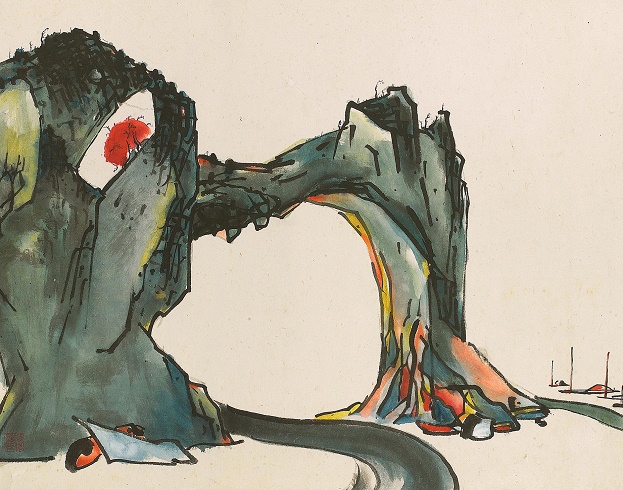
to their creation. I have chosen to illustrate here Bo
Yun's ink and colour on paper Lotus at Dawn (11), 68 by
68 cm, which can be interpreted by the viewer in several
ways. Zee Stone Gallery say Bo Yun's "landscapes at
dawn or dusk have a tranquil, dreamlike serenity as well
as a shade of pathos. Large areas of light and heavy ink
and mist and clouds dominate the paintings, setting off the
vastness of the land and sky". The exhibition which
they have entitled "Lost Horizon" runs from May
16th-31st and should be well worth a visit. For more information
contact gallery owner Shaun Kelly. |
I am always looking for
new affordable areas of collecting for our readers. William
Chiang, Director of China Art, G/F, 15 Hollywood Road,
Central, Hong Kong, has been collecting masks from China
since some time and has been fascinated by the craftsmanship
and the legends behind many of them. Until May 4th he is
exhibiting a show of 140 antique masks which he has priced
from HK$2000 to HK$20,000. William says, "Most of these masks come from western
China, from the regions of Guizhou province bordering Thailand
and Vietnam. The majority of the masks date from about 1800-1900,
although a few were made as early as 1700. Most are life-size
and were evidently worn by the performers, although we have
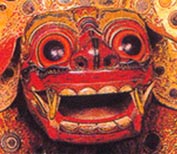
a few tiny ones that seem to have been amulets." Seen
here are two character masks worn in most Chinese dramas-the
intimidating judge (12) and the sweet young goddess (13)
who drives out evil spirits.

14 |

12
13 |
| We are happy to welcome Dennis
George Crow back to Hong Kong. The most recent occasion was
in April when he was scheduled to exhibit historic photographs
of Hong Kong, Macau and China. Dennis, who grew up in Hong
Kong and attended first the Peak School and later King George
V in Kowloon, has seen many changes since he was here as
a young boy. To recall those days and the years earlier I
have chosen to illustrate a view of the Peak Tram just above
May Road, 1950 (14). He also announces he has opened a new
gallery devoted to historic Asian photographs, art and antiquities.
This gallery at 138 North La Brea Avenue, Los Angeles, California
90036, USA has a large rotating inventory of images from
the Far East and other specialties. I recommend he be contacted
first for an appointment, Tel. and Fax: 323-932-0096.
|

15 |
For the first time the studio works of three great Japanese
ceramists-Makuzu Kozan, Seifu Yohei III and Ito Tozan-will
be shown with 19th century Japanese studio ceramics, on
display and for sale in New York City at Flying Cranes
Antiques Ltd until June 1st, 2003. Acclaimed in Japan during
the reign of Emperor Meiji (1868-1912), the artists' innovative
experimentation with rare glazes and new techniques were
shown at the Philadelphia Centennial Exposition in 1876.
For example, Makuzu Kozan's large and spectacular high-shouldered
vase (15), its body executed with a shimmering transmutation
glaze and oil-slick patina, Makuzu Kozan cartouche on base,
height 16.5 in, Meiji period.
|
Following ten years as curator
of textiles at the Los Angeles County Museum of Art, specialist
and author, Mary Hunt Kahlenberg (16) opened Tai Gallery/Textile
Arts in 1978. From May 17th through June 14th, 2003, Tai
Gallery presents "Textiles for Life's Transitions"-textiles
either as talismatic symbols of protection or to accentuate
the happiness of the moment. To celebrate its 25th Anniversary,
Rob Coffland (17) of Tai Gallery/Textile Arts, 616½ Canyon
Road, Santa Fe, New Mexico, will also introduce to collectors "the
amazing three dimensional bamboo sculptures and baskets being
created by Japan's contemporary masters" with a body
of new work by the Japanese bamboo master Nagakuru Kenichi.
The exhibition will run through July 18th. |

16 |

17 |

18 |
The 10th anniversary Spring auctions
of China Guardian Auction Co., Ltd will be held from May
17th - 22nd in the Kunlun Hotel, Beijing in seven categories:
Chinese Oil Paintings and Sculptures; Modern and Contemporary
Chinese Paintings and Calligraphy; Classical Chinese Paintings
and Calligraphy; Porcelain and Works of Art; Rare Books;
Stamps and Covers; Banknotes and Coins. With 600 plus lots
of modern painting masters from Wu Changshuo to Zhang Daqian,
etc, a highlight are sixty fans from the same collection
in good condition and reasonably estimated. The sale of Chinese
Oil Paintings and Sculpture includes works by Fang Junbi,
Pen Yuliang, Guan Liang, Wu Zuoren, Lin Fengmian and other
well-known names. The 1932 oil, Scenery of Hong Kong (18),
is from the later years of Li Tiefu (1869-1952).
|

19 |

20 |
I recently heard from Forrest
McGill, Chief Curator and Wattis Curator of South and Southeast
Asian Art, Asian Art Museum. He says about our January-February
2003 number, "Just wanted to thank you again for the wonderful
issue focusing on the Asian Art Museum. It turned out exceptionally
well, and we are in debt for a job so beautifully done. Copies
are in much demand here." The museum reopened to the
public on March 20th, 2003 in its new facility in San Francisco's
Civic Center. Illustrated here are four pictures of the
opening: the museum wrapped in banners created by artist
Pop Zhao (19); crowds gathered outside the museum for the
opening ceremonies (20); the front banner being raised
by Pop Zhao, lead donor Chong-Moon Lee, Commissioner Judy
Wilbur, Asian Art Museum Director Emily Sano and San Francisco
Mayor Willie Brown (21); and visitors to the Himalayan
galleries (22). |

21 |

22 |
 |
With this issue
we say farewell to Charlotte Horstmann whose friendship
dates to the 1950s long before the founding of this magazine.
My architect husband's partner helped to design Charlotte's
Duddell Street gallery, and assigned Charlotte as an interior
decorator to furnish some of the special suites in the
Mandarin Hotel for which he was the architect. The prestigious
hotel was opened in 1963.
My husband wrote with his illustrations the seven-page
article "Charlotte Horstmann's Ming Furniture" in
our May-June 1971 magazine. In this article Charlotte
is seen with her Ming (1368-1644) furniture in her earlier
Hong Kong days, including her famous "opium bed" now
in the Nelson-Atkins Museum of Art in Kansas City.
|
I remember vividly
Charlotte's sincere assertion when I talked to her in the
1970s at her elegant apartment on Castle Peak Road, Kowloon,
that she had deeply felt her Chinese roots and her Chinese
culture even from her early childhood. It was Charlotte's
love and enthusiasm that inspired and convinced her international
clients to buy classical huanghuali furniture for their
homes and offices. Her ability was to bring lesser known
subjects to wider international attention, such as Buddhist
art from Thailand and Burma.
To celebrate her ninetieth birthday I asked her daughter-in-law,
Victoria Horstmann, to write about Charlotte's life
and her achievements. This was published in the January-February
1999 issue of Arts of Asia under the title "Charlotte
Horstmann at Ninety". The tribute was acclaimed
internationally by readers amongst whom were many of
her close friends.
Last year I was invited with my son Michael to her
comfortable apartment in New York City. It was her
devoted daughter, Renata de Pepe, who prepared lunch
for us including pink champagne. For three and a half
hours Charlotte held our attention with her enthralling
memories, concluding with her first and most important
rule for success as an art and antique dealer: "please your clients
and maintain their confidence". Indeed, Charlotte
Horstmann will be remembered affectionately by all
who have known her and enjoyed her love of Asian art,
her warmth and her generous nature.
|
|
|
|